
Football Bankroll Management — Staking Plans That Actually Protect You
 Available in US
The Skill Most Punters Skip — Managing the Money
In 2017 I had a verified edge across Championship and League One markets. My strike rate was strong, my value identification was solid, and I still nearly went bust. The reason was not bad picks — it was bad staking. I was putting 5-8% of my bankroll on individual bets because I “felt confident,” and a run of seven consecutive losers wiped out three months of profit in a week. That experience taught me that finding value is only half the job. The other half is making sure your bankroll survives long enough for the value to materialise.
Bankroll management is the least exciting topic in football betting and the most important one. UK remote betting and casino operators held 24.4 million active accounts at the end of the last reporting quarter in 2025, with roughly £1.0 billion sitting in client balances. That is a lot of money managed — or mismanaged — by punters who often have no formal staking plan at all. Most people set a mental budget, ignore it after a losing Saturday, and top up their account on Monday. That is not a bankroll. That is a spending habit.
Flat Staking — Simplicity as a Strength
Every staking conversation should start with flat staking because it works, it is simple, and it removes the one variable most likely to sabotage you: emotional stake adjustment.
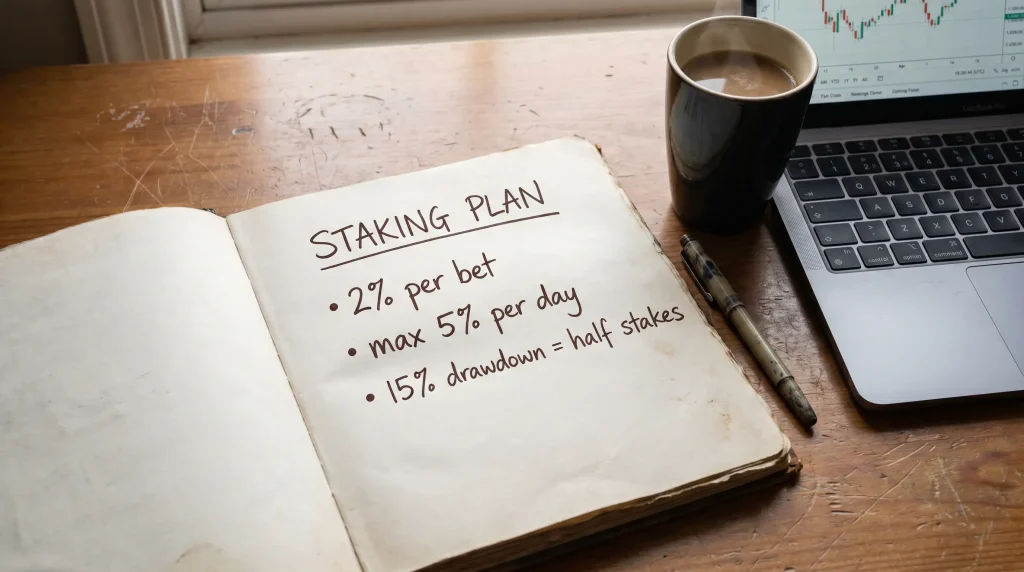
Flat staking means betting the same amount — or the same percentage of your starting bankroll — on every selection, regardless of confidence level. If your bankroll is £500 and you stake 2% per bet, every bet is £10. Your highest-conviction pick gets £10 and so does your least-certain selection. This feels wrong to most punters. Surely you should bet more when you are more confident? In theory, yes. In practice, punters are terrible at calibrating their own confidence. What feels like a high-conviction bet is often a bet on a team you support, or a bet at short odds that “cannot lose,” or a bet chasing a previous loss.

Flat staking eliminates that noise. Over a 200-bet sample, a flat staker with a genuine edge will grind out profit steadily. The returns will not be spectacular — they will look like a slightly upward-sloping line on a graph, with plenty of short-term dips. But the line goes up. And crucially, the maximum drawdown — the worst peak-to-trough decline — is controlled. With 2% flat stakes, even a 10-bet losing streak costs you only 20% of your bankroll. That is painful but survivable. At 5% stakes, the same losing streak costs 50%, and recovery becomes a mathematical mountain.

My recommendation for anyone without at least a year of tracked results: use flat staking at 1-2% of your bankroll. Build the track record first. Optimise the staking later.
Kelly Criterion — Optimal Sizing by Estimated Edge
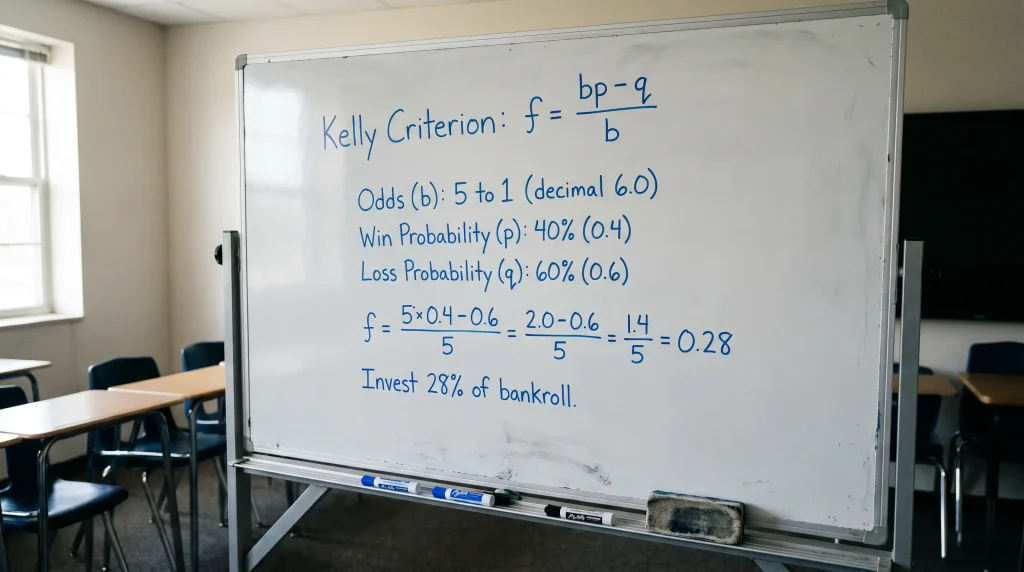
Once you have a verified track record showing calibrated probability estimates — meaning your 40% picks win roughly 40% of the time, your 60% picks win roughly 60% of the time — you can graduate to the Kelly Criterion. It is the mathematically optimal staking method for maximising long-run bankroll growth, and it is also the most misused.
The formula is f = (bp – q) / b, where f is the fraction of your bankroll to stake, b is the decimal odds minus 1, p is your estimated probability and q is 1 minus p. If you estimate a 55% chance of a bet winning at odds of 2.00, the Kelly fraction is (1 x 0.55 – 0.45) / 1 = 0.10 — meaning 10% of your bankroll. That is an aggressive stake for a single bet, and it illustrates Kelly’s biggest drawback: it assumes your probability estimate is perfectly accurate. If your 55% estimate is actually 50%, Kelly overstakes and the long-run result flips from profit to loss.
This is why I use fractional Kelly — typically half-Kelly or quarter-Kelly. Half-Kelly means dividing the Kelly-recommended stake by two. In the example above, that drops the stake from 10% to 5%. The expected growth rate decreases, but the protection against estimation error increases dramatically. With roughly 290 million bets placed monthly across UK online markets, the variance across that volume is enormous, and fractional Kelly keeps you in the game through the inevitable bad runs that full Kelly would amplify into account-threatening drawdowns.
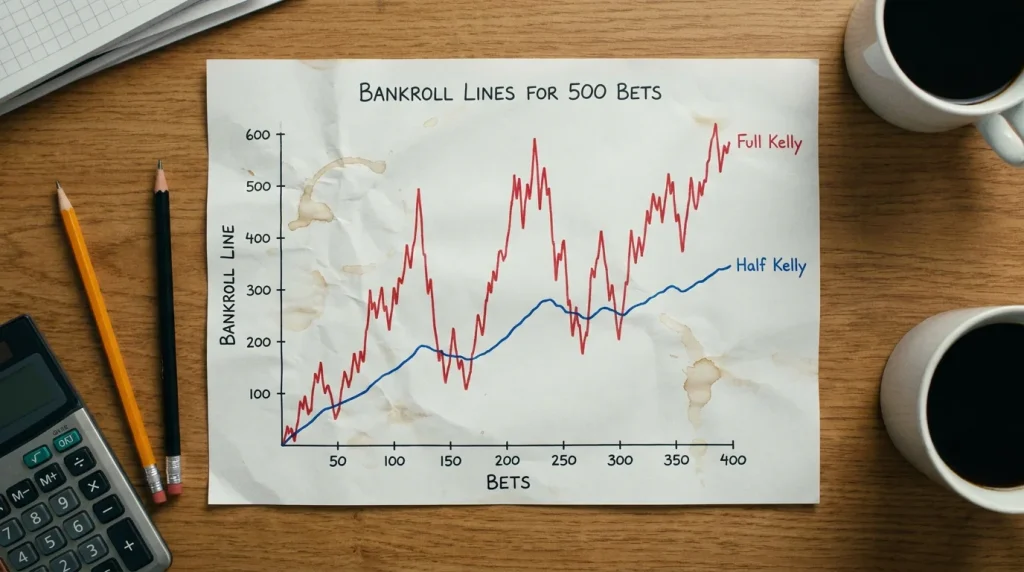
A practical note: Kelly requires you to input a probability estimate for every bet. If you are placing 10 bets per week, that is 10 probability estimates that all need to be reasonably accurate. Any systematic bias in your estimates — consistently overestimating your edge, for instance — will poison the Kelly calculation and lead to chronic overstaking. Test your calibration over at least 300 bets before trusting Kelly with real money.
Drawdown Rules — When to Stop and Reassess
The worst Saturday of my betting life came in October 2019. Six bets, all losses, all on matches I had modelled carefully. The seventh bet was placed out of frustration at 11pm on a random Mexican league match I knew nothing about. It lost. That seventh bet was the problem, not the first six. The first six were variance. The seventh was tilt — and tilt is a bankroll management failure, not an analytical one.
I now operate with hard drawdown limits. If my bankroll drops 15% from its peak in any rolling 30-day period, I reduce my stakes by half. If it drops 25%, I stop betting entirely for a minimum of two weeks and review my model’s recent performance. These limits are written down and non-negotiable. They exist because I know from experience that my decision-making deteriorates after sustained losses, and the only way to protect against deteriorating decisions is to automate the response.

The two-week pause is not about superstition or “resetting luck.” It is about reviewing whether the losing run represents normal variance within my model’s expected parameters or whether something has changed — a shift in market conditions, a flaw in my data source, or a bias that crept into my selections. If the review shows normal variance, I resume at half-stakes and rebuild confidence gradually. If it shows a genuine issue, I fix the issue before staking another pound.
One framework that helps: before the season starts, simulate your expected range of outcomes using your historical strike rate and average odds. If your edge is 5% at average odds of 2.00, a Monte Carlo simulation over 500 bets will show you the likely range of drawdowns. Seeing that a 20-bet losing streak has, say, a 12% chance of occurring at some point during the season makes it easier to handle when it actually happens. The drawdown was always coming — you planned for it, and your staking system is built to survive it. If the psychological side of handling losing runs interests you, the cognitive biases guide covers tilt management and debiasing techniques in depth.
How large should a football betting bankroll be to start?
Start with an amount you can afford to lose entirely without it affecting your finances or wellbeing. For most recreational punters, that is somewhere between £100 and £500. The absolute number matters less than the commitment to treating it as a fixed bankroll with percentage-based staking rather than topping it up from your current account after losses.
Is Kelly Criterion realistic for recreational punters?
Full Kelly is too aggressive for most recreational punters because it requires perfectly calibrated probability estimates. Fractional Kelly — half or quarter of the recommended stake — is more realistic and still captures most of the growth benefit with much less volatility. However, even fractional Kelly requires a verified track record of accurate probability estimates across at least 300 bets before it should be trusted over simple flat staking.
Articles
Created by the "Football Bet Today" editorial team.
