
Best Bookmakers for Football Betting in the UK — What to Compare and Why It Matters
 Available in US
Why Your Choice of Bookmaker Is a Betting Decision
For my first five years of football betting I used a single bookmaker for everything. One account, one app, every bet placed in the same place. It felt simple and efficient. It was neither. When I finally opened accounts with four additional operators and started comparing prices before every bet, my effective return improved by roughly 3% across all markets without changing a single selection. Three percent sounds modest. Over a year of regular betting it was the difference between a losing record and a profitable one.
The UK has one of the most competitive licensed betting markets in the world. The Gambling Commission oversees every operator, and the remote betting sector generated GBP 7.8 billion in gross gaming yield in the year to March 2025. That scale supports dozens of licensed bookmakers competing for your custom, and the competition produces meaningful price differences on the same fixtures, the same markets, and the same selections. Ignoring those differences is leaving money on the table with every bet you place.
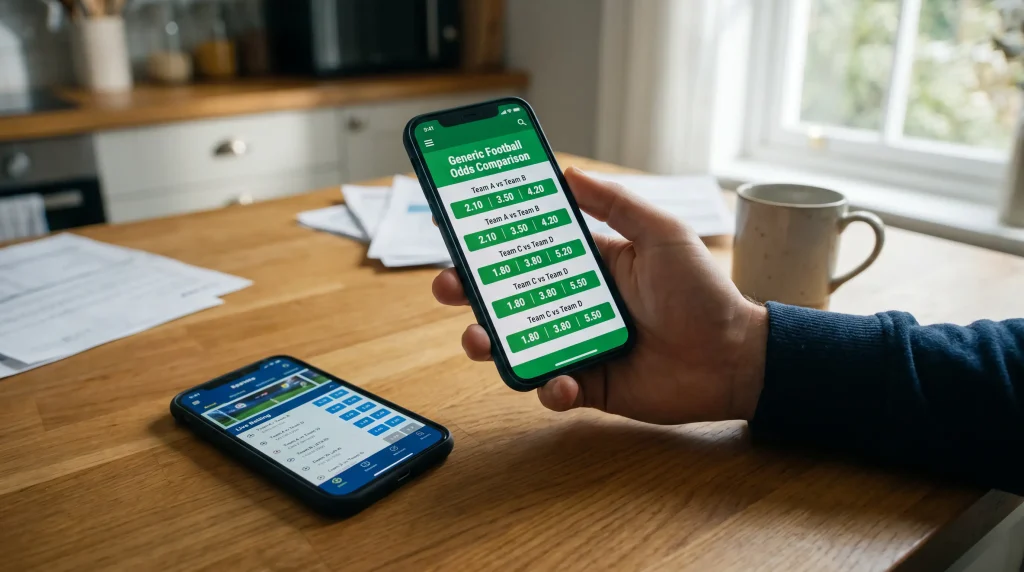
This is not a ranking of bookmakers. I am not going to tell you which operator is “best” — that depends on what you bet on, how you bet, and which features matter to your specific approach. What I will do is break down the variables that actually affect your bottom line and show you how to evaluate them for yourself.
Overround Comparison — the Variable That Costs You Most
If there is one number every football punter should check before opening a new account, it is the average overround on the markets they bet most. The overround is the bookmaker’s built-in margin — the percentage above 100% that the implied probabilities in a market sum to. A match-result market with a 103% overround takes a 3% cut from the true probabilities. A market at 106% takes 6%.
I track overrounds weekly across five UK bookmakers on Premier League match-result markets. The range is consistent: the tightest operator averages 102.5-103.5%, while the widest averages 105-107%. That 3-4 percentage point spread is enormous over hundreds of bets. A punter placing 10 bets per week at GBP 20 per bet — GBP 10,400 in annual turnover — saves approximately GBP 310-GBP 415 per year by consistently using the tightest-margin operator versus the widest.

The overround varies by market type within the same bookmaker. An operator that runs tight margins on match result might run wide margins on correct score, and vice versa. I maintain a simple spreadsheet that logs which bookmaker offers the best effective margin on each market type — 1X2, Asian handicap, totals, BTTS, goalscorer — and I route my bets accordingly. It takes five minutes per week to update and it is the single easiest way to improve your long-term returns without any analytical skill whatsoever. Sports betting accounts for 57.1% of UK online gambling revenue, and within that market the margin differences between operators are your simplest available edge.
Market Depth and Coverage — Niche Leagues and Peripheral Markets
A bookmaker that prices 40 markets on a Premier League fixture but only 8 markets on a League Two fixture is limiting your opportunities in the divisions where value is most abundant. Market depth — the number of betting options available per fixture — varies significantly between operators and is a genuine differentiator for punters who bet beyond the Premier League.
I check three things when evaluating an operator’s market depth. First, does it cover all four tiers of English professional football with at least match result, totals, BTTS and Asian handicap markets? Some operators offer League One and League Two fixtures but with only 1X2 pricing, which limits your options. Second, does it price European leagues beyond the top five? If you bet on the Eredivisie, the Portuguese Primeira Liga, or the Scottish Premiership, some UK bookmakers offer comprehensive coverage while others treat these as afterthoughts with wide margins and thin market selection. Third, does it offer player-level markets — goalscorer, shots, cards — on lower-league fixtures? The answer is almost always no for League Two, but some operators extend player markets to League One and the Championship, which opens up value opportunities that competitors do not offer.
The Remote Gaming Duty rose to 40% in April 2026, and that increase has already started affecting market depth at some operators. Peripheral markets with low betting volume are expensive to price and maintain. Some bookmakers have quietly reduced their lower-league offerings since the duty increase, consolidating their pricing resources on the high-volume markets where the economics still work. If you bet on lower leagues or niche markets, checking that your operator still covers them properly is more important now than it was a year ago.
Cash-Out, In-Play Speed and Mobile Experience
In-play betting accounts for more than 70% of UK sports wagers, and the quality of a bookmaker’s live betting product varies wildly. The two variables that matter most for in-play punters are latency and market suspension frequency.

Latency is the delay between the live action and the odds updating on your screen. A bookmaker with a two-second delay gives you a narrow window to act on information — a dangerous attack, a near-miss, a tactical substitution — before the odds adjust. A bookmaker with a five-second delay gives you a wider window. I have found that latency differences between operators on the same fixture can exceed three seconds, which is an eternity in live betting. The operator with faster updates is pricing more accurately in real time, which is better for the bookmaker but worse for the punter seeking to exploit momentary mispricing. Paradoxically, the “slower” live product can be more profitable for a disciplined in-play bettor.
Market suspension frequency — how often the bookmaker suspends live betting during key match events — is the other critical factor. Some operators suspend markets for 10-15 seconds around every shot on target, corner, or booking. Others suspend only for goals and red cards. Frequent suspensions reduce your in-play betting opportunities and make it harder to execute pre-planned triggers. If your in-play strategy depends on acting within a specific match-state window, a bookmaker that suspends markets every time a corner is taken will frustrate that strategy regardless of how good their odds are.
Cash-out quality deserves mention because it varies more than most punters realise. The cash-out offer is essentially a new bet at the bookmaker’s current in-play price, minus a margin. Some operators build a 5-6% margin into cash-out offers. Others build 8-10%. Over a season of 50 cash-out decisions, the difference between a 5% and a 10% margin is material.
Account Restrictions and Long-Term Viability
Here is the reality that no bookmaker advertises: if you bet profitably and consistently, some operators will restrict your account. Stake limits get reduced, certain markets become unavailable, and promotional offers stop appearing. This is legal, common, and — from the bookmaker’s perspective — rational. They are businesses, and a consistently profitable customer is a cost centre.
My approach to managing this reality is diversification. I spread my betting activity across multiple operators so that no single bookmaker sees enough volume to flag my account as sharp. I use each operator for the markets where they offer the best price rather than concentrating all my activity in one place. I avoid patterns that trigger automated detection — placing large bets immediately after price movements, consistently taking the highest available price within seconds of it appearing, or betting exclusively on obscure markets where sharp activity is easier to isolate.
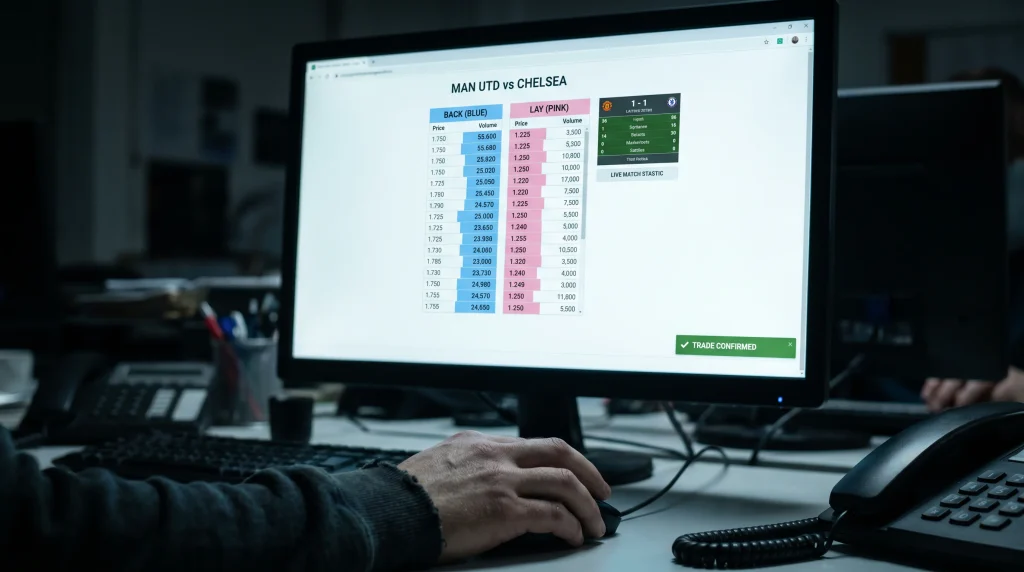
Exchange accounts are the long-term hedge against bookmaker restrictions. Exchanges do not restrict winning customers because the exchange earns commission on every matched bet regardless of who profits. The trade-off is that exchange liquidity on lower-league fixtures is thin, and the prices are not always competitive with the best bookmaker odds on high-profile matches. I use exchanges as my primary platform for in-play betting and as a backup for any market where my bookmaker accounts have been restricted. For a detailed look at how exchange-based strategies like lay betting work, the strategy guide covers the mechanics and the maths.
How many bookmaker accounts should a serious football punter maintain?
I recommend maintaining active accounts with at least four to five licensed UK bookmakers plus one exchange account. This gives you sufficient price comparison coverage across major markets, reduces the risk of account restrictions at any single operator, and ensures you always have access to the best available price on any selection. The marginal effort of checking multiple apps before each bet is minimal compared to the cumulative value improvement.
Does the 2026 duty increase affect which bookmaker offers the best odds?
Yes. Different operators have absorbed and passed through the duty increase at different speeds and in different proportions. Some have widened margins uniformly across all markets. Others have protected their flagship match-result pricing while widening margins on peripheral markets. The relative ranking of bookmakers by effective margin has shifted since April 2026, making regular overround tracking more important than relying on pre-increase comparisons.
Articles
Prepared by the Football Bet Today editorial staff.
