
Football Betting Strategy Guide — Structured Systems Beyond Gut Instinct
 Available in US
A Strategy Is Not a Tip — Why Systems Outperform Hunches
For the first three years of my betting life, I had tips but no strategy. I followed selections, reacted to results, adjusted stakes based on how I felt, and wondered why my bankroll never grew despite picking plenty of winners. The missing piece was a system — a repeatable process that dictated not just what to bet on but how to bet, how much to stake, and when to step away. The day I started treating betting as a system rather than a collection of individual decisions was the day my long-term results turned positive.
Sports betting accounts for 57.1% of UK online gambling revenue, and within that enormous market the overwhelming majority of punters operate without any structured approach. They follow tips, back their gut, increase stakes after losses and decrease them after wins — the exact opposite of what profitable systems prescribe. A strategy removes emotion from the equation and replaces it with rules. Rules are boring. Rules are also profitable.
This guide covers three systems that I have used at different points over the past decade. None is a magic formula. Each has specific strengths, specific weaknesses, and specific situations where it works best. The common thread is structure — every system tells you in advance what to do in every scenario, so you never have to make a decision under emotional pressure.

Dutching — Spreading Risk Across Outcomes
Dutching is the technique of backing multiple outcomes in the same market, calculating stakes so that the profit is the same regardless of which selection wins. It sounds counterintuitive — why back more than one outcome? — but in specific situations it is a powerful way to extract value when you believe the bookmaker has underpriced two or more outcomes simultaneously.
Here is a concrete example. Suppose a match has three 1X2 outcomes priced at Home 2.50, Draw 3.40, Away 3.20. The combined implied probability is 107.4%, meaning the bookmaker’s overround is 7.4%. Now suppose your analysis says the draw and away win are both more likely than the bookmaker’s prices imply, but you are uncertain which one will materialise. You can Dutch the draw and away win by calculating stakes that return the same profit on either outcome.
The maths: for a total outlay of £20, stake £9.60 on the draw (potential return £32.64) and £10.40 on the away win (potential return £33.28). Either way, your return is approximately £32.50-£33.30 for a £20 outlay — a profit of roughly £12.50-£13.30 if either the draw or away win lands. If the home team wins, you lose £20. The strategy is profitable if the combined probability of draw and away win exceeds the combined implied probability of both prices minus the Dutching cost.
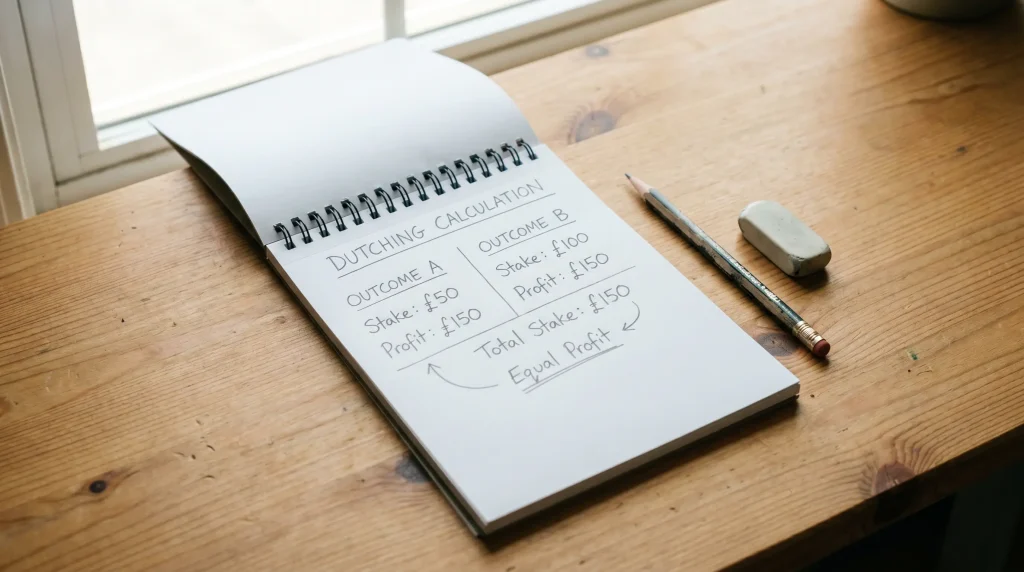
I use Dutching most often in matches where I am confident the favourite is overpriced — where public money has compressed the home or away win price below fair value — but I cannot distinguish between the draw and the other result. Rather than guessing which non-favourite outcome will land, I back both and let the maths handle the allocation.
Lay Betting on Exchanges — When to Back Against a Result
Lay betting is the reverse of a standard bet: instead of backing an outcome to happen, you are offering odds against it. If you lay a home win, you profit when the home team draws or loses and you lose when the home team wins. Betting exchanges facilitate this by matching your lay bet against another punter’s back bet.
Roughly 290 million online bets are placed monthly across UK sports markets, and a growing share of sophisticated bettors use exchanges for laying rather than traditional bookmakers for backing. The advantage of laying is that it gives you two outcomes in your favour for every one against — laying the home win means you win on draw or away result, losing only on home win. The disadvantage is that your liability — the amount you stand to lose — is larger than your stake, because you are acting as the bookmaker.
I lay bets in two situations. First, when I believe a favourite is significantly overpriced. If a team is priced at 1.50 on the 1X2 — implying 67% — and my model puts their win probability at 55%, laying them at 1.50 on the exchange gives me a 45% chance of profit with an edge of roughly 12 percentage points. Second, when I want to trade a position. I might back a team pre-match and then lay them in-play after the price has shortened, locking in profit regardless of the final result. This is closer to financial trading than traditional betting, and it requires exchange-specific skills around timing and liquidity.
The critical discipline with lay betting is liability management. A lay bet at 5.00 means your liability is four times your potential profit. A losing run of lay bets at long odds can drain a bankroll much faster than a losing run of standard bets at the same odds. I cap my lay liability at 3% of my bankroll per bet, which limits the damage from any single loss.

Matched Staking — Risk-Free Extraction From Free Bets
Matched betting — or matched staking, as I prefer to call it — is the closest thing in football betting to a guaranteed profit, and it is how I initially built my bankroll before transitioning to value betting full-time.
The principle exploits the gap between bookmaker promotional offers and exchange lay prices. A bookmaker offers a “bet £10, get £10 free bet” promotion. You place the qualifying bet at the bookmaker and simultaneously lay the same outcome on an exchange, cancelling out the risk. When the free bet arrives, you use it on a selection at the bookmaker and lay the same selection on the exchange again. The free bet either wins at the bookmaker — in which case the exchange lay loses, but the net profit is the free bet value minus the exchange commission and any odds gap — or the free bet loses at the bookmaker, in which case the exchange lay wins and you keep the lay profit.
The maths varies by offer, but a typical “bet £10, get £10 free” promotion yields £7-£9 in guaranteed profit with zero risk. Scale that across 20 or 30 bookmakers offering welcome promotions and the initial bankroll builds to £200-£300 before you have placed a single genuine bet. Ongoing reload offers — free bets for existing customers — provide a steady trickle of additional risk-free profit throughout the year.

Matched staking is not a long-term strategy for building wealth — the offers dry up, accounts get restricted, and the per-offer profit shrinks as you exhaust the welcome bonuses. But it is an excellent way to build a starting bankroll for value betting without risking your own money. If you want to understand how to protect that bankroll once it is built, the bankroll management guide covers staking plans designed for exactly that purpose.

Is Dutching a viable long-term strategy for football betting?
Dutching is viable when you can consistently identify matches where two or more outcomes are underpriced relative to the favourite. It works best as a complement to standard single betting rather than a standalone strategy. The maths requires careful stake calculation, and the edge depends on the accuracy of your probability estimates for the non-favourite outcomes. Over large samples, systematic Dutching against overpriced favourites can produce positive returns.
What is the difference between lay betting and simply backing the opposite outcome?
Backing the opposite outcome on a standard bookmaker gives you one winning result. Laying an outcome on an exchange gives you two — everything except the laid result wins. The pricing is different because exchange prices reflect peer-to-peer supply and demand without the bookmaker"s overround. Lay betting also carries higher liability per bet, since you are effectively acting as the bookmaker on that outcome, which requires stricter stake management.
Articles
Created by the "Football Bet Today" editorial team.
