
Football Betting Odds Explained — Fractional, Decimal and Implied Probability
 Available in US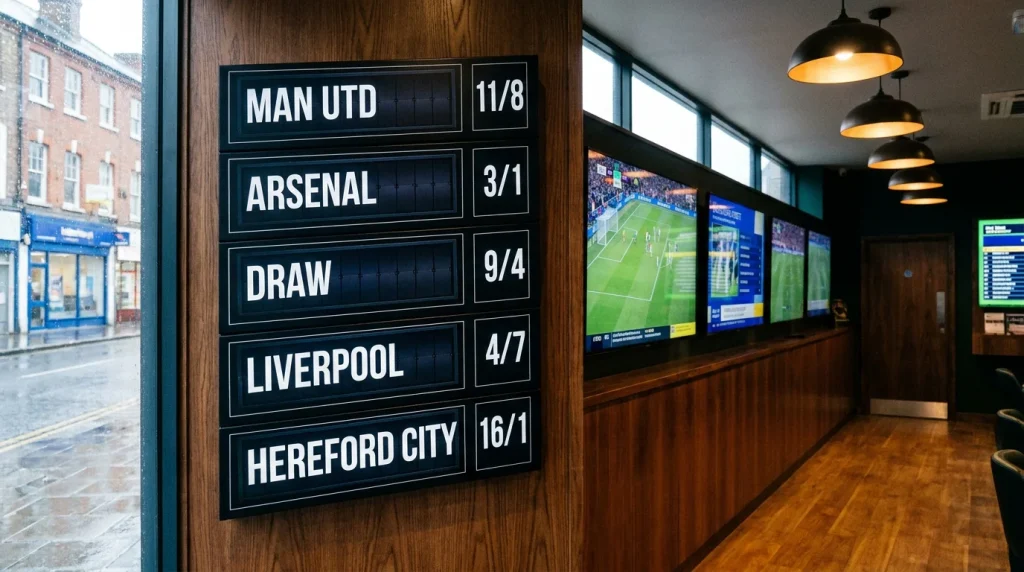
Odds Are a Language — Here’s How to Read Them
For years I thought I understood odds. I could read a price, calculate a payout, and decide whether I liked the number. What I did not understand — and what cost me money until I did — was what the number actually meant beneath the surface. Odds are not just a payout multiplier. They are the bookmaker’s opinion on the probability of an outcome, disguised as a price, inflated by a margin, and served to you as if it were a fair deal. Learning to strip away that disguise is the single most important skill in football betting.
Sports betting commands 57.1% of all UK online gambling revenue, making it the largest segment of the market. Every pound of that revenue passes through odds — prices set by bookmakers and accepted by punters. If you bet regularly and cannot convert odds into probability in your head within a few seconds, you are navigating that market blind. This guide fixes that.
Fractional vs Decimal — Converting and Comparing
Walk into any high-street bookmaker in Britain and the odds are displayed as fractions — 5/2, 11/4, 8/11. Open a betting app and you might see the same prices in decimal format — 3.50, 3.75, 1.73. They represent exactly the same thing, just expressed differently, and the ability to switch fluently between the two is a basic requirement for comparing prices across platforms.
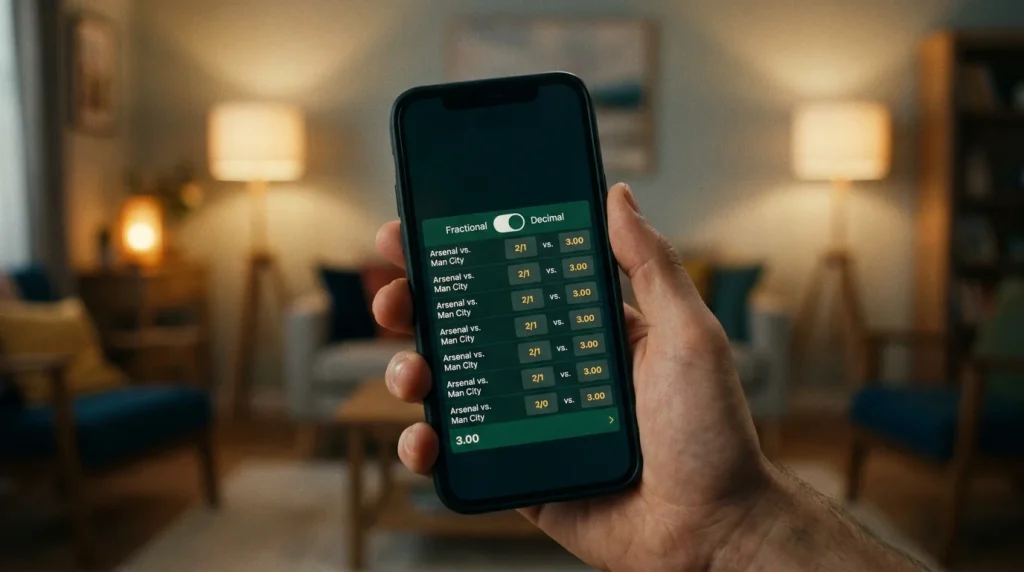
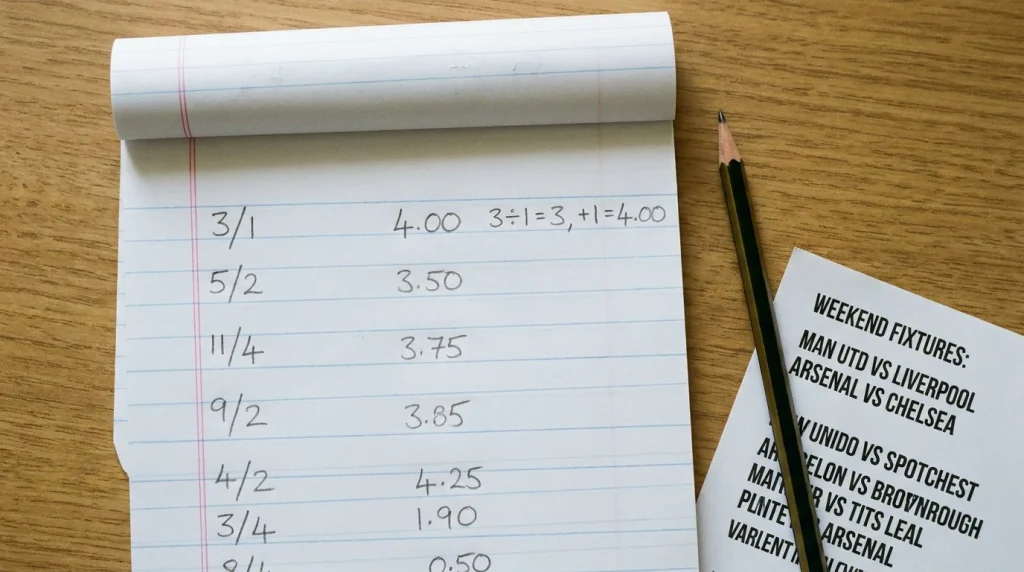
Fractional odds tell you your profit relative to your stake. At 5/2, you profit £5 for every £2 you stake. Your total return is £7 — the £5 profit plus your original £2 back. Decimal odds tell you your total return per unit staked, including the stake itself. At 3.50, you receive £3.50 back for every £1 you stake, of which £2.50 is profit. To convert fractional to decimal, divide the first number by the second and add 1. So 5/2 becomes (5 / 2) + 1 = 3.50. To convert decimal to fractional, subtract 1 from the decimal, then express as a fraction. 3.50 minus 1 equals 2.50, which is 5/2.
Decimal format is objectively better for comparison. When you see 2.10 next to 2.20, you instantly know the second price pays more. When you see 11/10 next to 6/5, the comparison requires mental arithmetic. I switched to decimal years ago for all my analysis and I recommend the same. Use fractional when placing bets at a high-street shop where it is the standard format, but do your thinking in decimal.
A practical exercise: pick five fixtures from this weekend’s schedule and write down the home win, draw and away win odds in both formats. Convert them yourself without a calculator. Within a week of doing this daily, the conversion becomes automatic.
Implied Probability — What the Price Actually Says
This is where odds stop being a payout multiplier and start being an analytical tool. Every set of odds implies a probability — the bookmaker’s estimate of how likely that outcome is to happen, plus their margin.
The conversion from decimal odds to implied probability is one division: 1 divided by the decimal odds. At 2.50, the implied probability is 1 / 2.50 = 0.40, or 40%. At 1.50, it is 1 / 1.50 = 0.667, or 66.7%. At 5.00, it is 1 / 5.00 = 0.20, or 20%. Football generates £1.1 billion in gross gaming yield annually in the UK, and every penny of it flows through this conversion. The punters who understand implied probability are swimming with the current. The ones who do not are swimming against it.
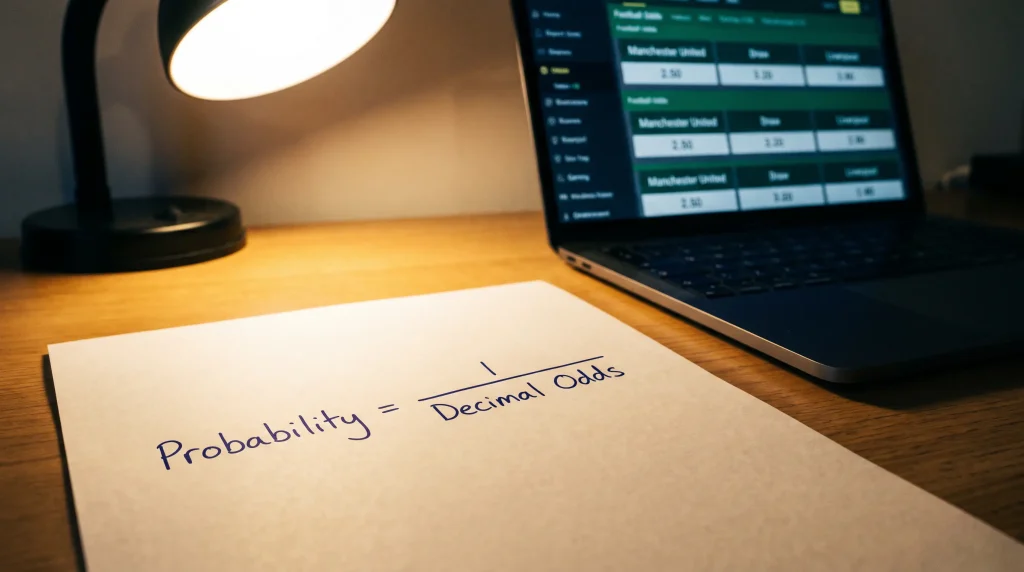
From fractional odds, the formula is denominator / (numerator + denominator). At 6/4, the implied probability is 4 / (6 + 4) = 0.40, or 40%. At 1/2, it is 2 / (1 + 2) = 0.667. Same numbers, same meaning, different expression.
Once you can convert odds to implied probability fluently, you unlock the ability to compare any price against your own assessment of how likely an outcome is. If you believe a home win has a 50% chance and the bookmaker’s implied probability is 40%, the gap is your potential edge. If you believe it has a 35% chance and the bookmaker implies 40%, the bookmaker has the edge and you should not bet. Everything else in football betting — xG models, form analysis, team news — is just a method for generating your own probability estimate. The implied probability comparison is where that estimate becomes an actionable decision. For a deeper exploration of how to calculate and exploit those gaps, the value betting guide walks through edge calculation step by step.
The Overround — Bookmaker Margin in Every Market
Here is the detail that separates informed punters from everyone else. Add up the implied probabilities for every outcome in a market. In a perfectly fair market, they sum to 100% — each outcome’s probability reflects reality and the bookmaker takes no cut. In an actual market, they sum to more than 100%. The excess is the overround, and it is how bookmakers guarantee themselves a profit regardless of which outcome wins.
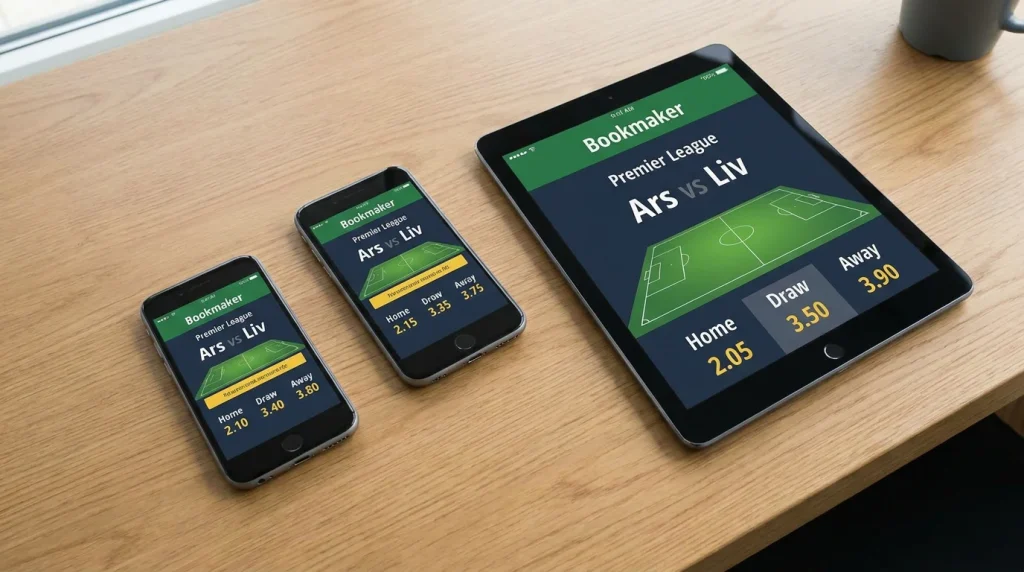
Take a Premier League match where the home win is priced at 2.10 (47.6%), the draw at 3.40 (29.4%), and the away win at 3.80 (26.3%). Those implied probabilities sum to 103.3%. The 3.3% overround is the bookmaker’s margin, distributed across the three outcomes. On a less liquid market — correct score, for instance — the overround might be 140% or higher. That margin is the price you pay for the privilege of betting, and it is the primary obstacle between you and long-term profit.
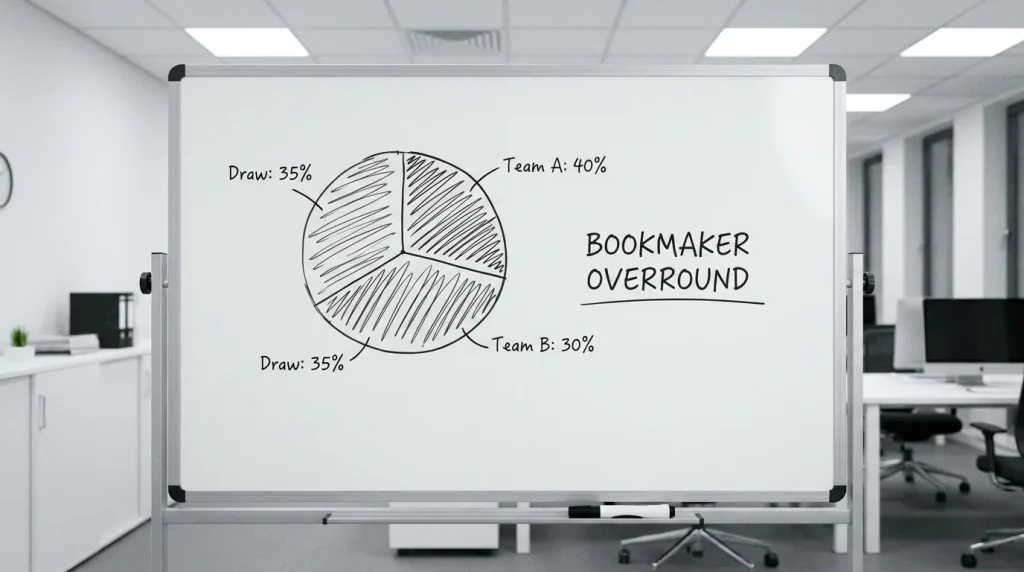
Different bookmakers apply different overrounds to the same match. One might price a fixture at 102.5% and another at 106%. Over hundreds of bets, the difference between those two margins is significant — a 3.5% difference in overround translates directly into 3.5% more value available in every market. This is why serious punters hold accounts with multiple bookmakers and always compare prices before placing a bet. The five seconds it takes to check three or four prices is the easiest edge improvement available.
I track the average overround by bookmaker and by market type in my spreadsheet. Over time, clear patterns emerge — some bookmakers consistently run tighter margins on match result but wider margins on totals, and vice versa. Knowing which bookmaker to use for which market is a small but compounding advantage that costs nothing to implement.

Why do the implied probabilities of a football match add up to more than 100%?
The excess above 100% is the bookmaker"s overround — their built-in profit margin. By inflating the implied probability of every outcome slightly, the bookmaker ensures that the total price paid by punters across all outcomes exceeds the total payout. The size of the overround varies by bookmaker and market type, typically ranging from 102-106% on match result markets to 130-180% on more exotic markets like correct score.
Are decimal odds more useful than fractional for spotting value?
Decimal odds are easier to compare directly — 2.10 versus 2.20 is immediately clear, while 11/10 versus 6/5 requires mental conversion. More importantly, converting decimal odds to implied probability is a single division, making the analytical step from price to probability faster. For anyone doing regular value analysis, decimal format reduces friction and errors.
Articles
Published by the Football Bet Today team.
