
AI Football Betting Predictions — What Machine Learning Actually Does to the Odds
 Available in US
The AI Arms Race You Are Already Losing
In 2019 I entered a prediction competition against a machine learning model built by a data scientist I know. We each predicted 200 Premier League match outcomes over the course of a season. My model was a carefully tuned Poisson framework with manual adjustments for form, injuries and tactical matchups. His was a gradient-boosted decision tree trained on 15 seasons of match data with 47 input features. I won — by 0.3%. That margin was close enough to keep me humble and close enough to make me start paying serious attention to what AI is doing to football betting markets.
The global AI-in-sports-betting market reached $10.8 billion in 2025 and is projected to exceed $60 billion by 2034. Those numbers represent the scale of investment in algorithmic pricing, automated trading, and machine learning models that power every bookmaker’s odds engine. The bookmaker you bet against in 2026 is not a person in a back room adjusting prices based on experience. It is a suite of models processing live data, historical patterns, and market flows faster than any human can process a single match preview. Understanding what those models do — and where they fail — is essential for any punter who wants to survive in this market.

How Bookmaker AI Prices a Football Match
I spoke at length with a former pricing analyst from a major UK bookmaker, and the process he described was both impressive and surprisingly imperfect. The pricing pipeline starts with a base model — typically an Elo or regression model — that generates raw probabilities for each match outcome based on team strength ratings. Those raw probabilities are then adjusted by a secondary model that incorporates form, injuries, venue effects, and head-to-head records. A third layer applies the overround — the margin — distributing it across outcomes based on expected betting patterns.
The AI component sits primarily in the second layer. Machine learning models — random forests, neural networks, gradient boosters — process far more variables than a human analyst can hold in their head simultaneously. They find non-linear relationships between inputs and outcomes that linear models miss. A neural network might discover that a specific combination of home team pressing intensity, away team passing accuracy, and referee booking rate predicts a draw more accurately than any of those inputs alone. That kind of interaction effect is invisible to a human but detectable in the data.
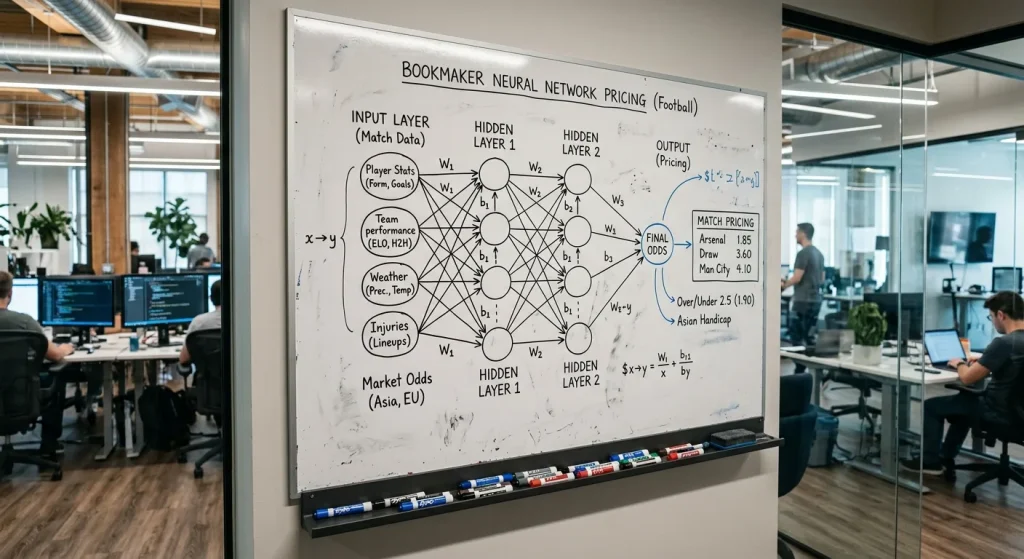
Sports betting generates 57.1% of UK online gambling revenue, and the AI models powering that market are genuinely sophisticated. But sophistication does not equal perfection. The models are trained on historical data, which means they are optimised for patterns that have occurred before. Novel situations — a new manager implementing a radical tactical shift, a team’s first season in a new league, the introduction of a rule change — produce conditions the model has not seen, and its predictions in those scenarios are less reliable than its predictions in familiar territory.
Where AI Models Underperform — and Where Punters Still Have an Edge
After five years of studying this question, I have identified three consistent gaps in bookmaker AI pricing.
First, managerial transitions. When a new manager takes charge mid-season, the AI model’s team-strength rating is anchored to the previous manager’s record. It adjusts gradually as new results come in, but the adjustment lags behind the actual tactical shift. A new manager who immediately changes the formation, pressing structure, and set-piece routines produces a team that plays fundamentally differently from the one the model was trained on. The first four to six matches under a new manager represent a pricing window where the model’s estimates are least reliable. I have found consistent value backing teams with a significant tactical upgrade at manager level in their first month of fixtures.

Second, motivation asymmetries. AI models are excellent at pricing team strength but poor at pricing motivation. A dead rubber between two mid-table sides in the penultimate week of the season looks identical to a high-stakes fixture between the same sides in October from a team-strength perspective. But the motivation levels are completely different, and the difference affects effort, risk-taking, and tactical approach in ways that shift outcome probabilities by 5-10 percentage points. Models struggle with motivation because it is not consistently captured in historical data — motivation is situational, and the same team in the same position can be motivated or apathetic depending on context that the model cannot quantify.

Third, micro-market pricing. The bookmaker’s AI dedicates its greatest precision to the markets that attract the most volume — match result, totals, and Asian handicap. Peripheral markets — corners, cards, player shots, half-time/full-time — are often priced by secondary models or derived algorithmically from the primary model’s output. Those derived prices carry larger margins and less manual oversight, creating more frequent mispricings. Helen Rhodes at the Gambling Commission has noted the complexity of the modern betting landscape, and nowhere is that complexity more exploitable than in markets where the pricing model’s attention is lowest.
Building Your Own Model in an AI-Dominated Market
You do not need a machine learning model to beat one. The edge for individual punters does not come from out-computing the bookmaker — that race is lost before it starts. It comes from processing information the bookmaker’s model handles poorly or not at all.
My model uses four metrics, runs on a spreadsheet, and takes about 20 minutes per fixture to produce a probability estimate. It is not impressive technology. What makes it profitable is that it incorporates contextual adjustments — managerial changes, motivation levels, squad rotation patterns — that the bookmaker’s AI handles through blunt historical averages rather than fixture-specific analysis. A punter who watches football closely, tracks tactical shifts manually, and understands the specific dynamics of a fixture can outperform a model that processes 50 variables mechanically but misses the human context that the data does not capture.
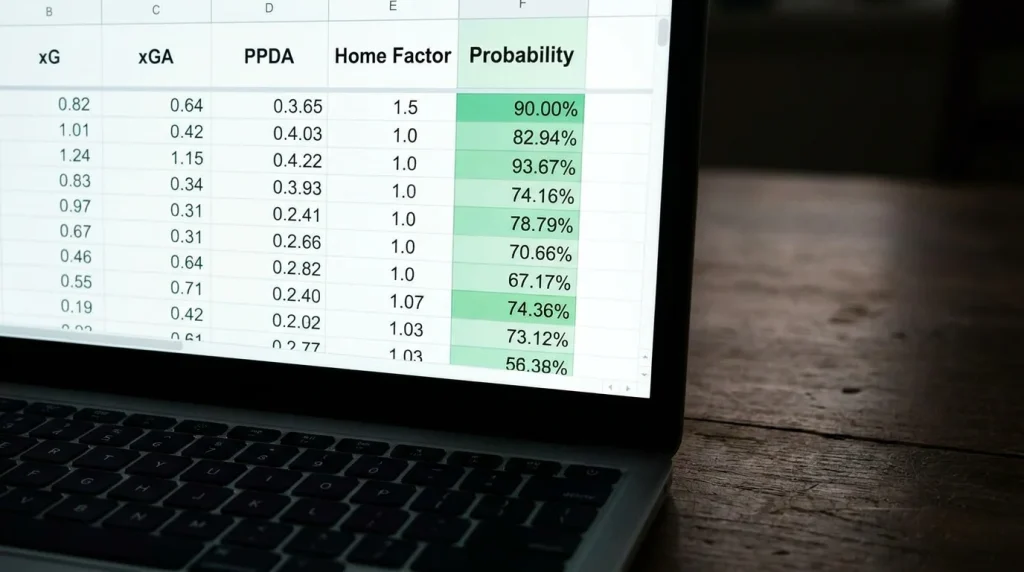
The practical implication is to focus your betting on matches where your contextual knowledge adds something the AI model cannot replicate. Premier League fixtures between stable, mid-table sides in routine gameweeks are the worst candidates — the AI model handles these accurately because the patterns are familiar and the context is unremarkable. The best candidates are matches with novel elements: a new manager, a crucial relegation six-pointer, a team returning from midweek European travel with confirmed rotation. Those are the fixtures where your 20-minute manual analysis adds genuine predictive value that the AI’s 200-variable model cannot match. For a broader look at how statistical metrics feed into betting models, the stats for betting guide covers which numbers are worth building around.
Can individual punters still profit against AI-powered bookmaker models?
Yes, but the edge has shifted. Beating the bookmaker on raw prediction accuracy across all matches is extremely difficult. The viable edge for individuals lies in contextual factors that AI models handle poorly — managerial transitions, motivation asymmetries, and fixture-specific tactical dynamics. Focusing betting activity on matches with these novel elements, rather than spreading bets across the full fixture list, concentrates your analytical advantage where it matters most.
How quickly do bookmaker AI models adjust to new information?
Primary markets like match result adjust within minutes of significant news — a confirmed injury to a key player, for instance. Secondary markets adjust more slowly, sometimes not until shortly before kick-off. The adjustment is also imperfect for novel situations like managerial changes, where the model"s historical training data provides limited guidance. The first four to six matches after a major tactical shift represent the period of greatest model uncertainty and therefore the largest pricing windows.
Articles
Published by the Football Bet Today team.
