
How to Bet on Football in the UK — A Step-by-Step Beginner's Guide
 Available in US
Your First Football Bet — What to Know Before You Start
Everyone remembers their first bet. Mine was a Saturday afternoon in 2009 — I walked into a high-street bookmaker with a tenner and backed a Premier League home win at 4/5. I had no idea what 4/5 meant, no clue how the payout worked, and I spent the entire second half refreshing a text-based live scores page on a phone that could barely load it. The team won 1-0 and I collected £18. I was hooked. What I was not, unfortunately, was informed — and the next six months of uninformed betting cost me considerably more than £18.

This guide exists to give you the start I did not have. About 10% of the UK population bets online on sport in any given year, and 47% participate in some form of gambling. If you are about to join that group through football betting, understanding the basics properly before you place your first wager will save you money and frustration. There is no shortcut to experience, but there is a shortcut past the most common beginner mistakes.
Football betting in the UK is legal, regulated and accessible to anyone aged 18 or over. The UK Gambling Commission licenses every bookmaker operating in the country, and those operators must meet strict standards around fairness, responsible gambling tools and customer fund protection. You are betting in one of the most tightly regulated markets in the world, which is a genuine advantage — the rules are clear, the operators are accountable, and your rights as a customer are codified in law.

Opening a Betting Account in the UK
The process is straightforward but involves a few steps that catch some new punters off guard. You will need to be 18 or over — no exceptions. The bookmaker will verify your identity using your name, date of birth, and address, usually through an automated check against electoral roll and credit reference data. Some accounts are verified instantly. Others require you to upload a photo of your driving licence or passport, particularly if the automated check flags a discrepancy.
Online platforms dominate UK sports betting, accounting for 78.47% of total revenue in the sector. Most new accounts are opened on a mobile phone, and the typical process takes five to ten minutes from download to confirmed account. You will set a username and password, enter your personal details, and choose a deposit method — debit card is the standard option, though bank transfer and e-wallets are widely available. Credit cards are banned for gambling deposits in the UK, a regulation that came into effect in 2020.

One important step that many beginners skip: set your deposit limits immediately after opening the account. Every licensed UK bookmaker is required to offer deposit limit tools — daily, weekly and monthly caps that prevent you from depositing more than you intend. Setting a limit before you start betting is far easier than setting one after a losing streak when the temptation to chase is strongest. Pick a weekly figure that you can genuinely afford to lose, set it as your deposit limit, and treat it as a hard boundary.

Football Betting Markets Explained — From 1X2 to Specials
Walking into a football betting market for the first time feels like arriving in a foreign country where everyone speaks a language you almost recognise. The terminology is not complicated once someone explains it, but nobody explains it — they just assume you already know. So here is what the main markets actually mean.
The 1X2 market is the most basic: 1 means home win, X means draw, 2 means away win. You pick one of three outcomes and the bookmaker pays you according to the odds if you are right. This is match result betting and it is where most new punters start.
Both teams to score — BTTS — is a yes/no market on whether both sides find the net during the match. It does not matter who wins or what the final score is. If you back BTTS Yes and the match finishes 3-2 or 1-1, you win. If it finishes 1-0, you lose. Over/under goals works similarly — you bet on whether the total number of goals in the match will be above or below a specified line, typically 2.5. Over 2.5 goals wins if there are three or more goals; under 2.5 wins if there are two or fewer.
Correct score is a bet on the exact final scoreline — 1-0, 2-1, 0-0, and so on. The odds are longer because the probability of any specific scoreline is low. First goalscorer and anytime goalscorer are bets on individual players scoring — the first goal of the match, or any goal at any point. Handicap betting gives one team a virtual head start or deficit — a -1 handicap on the home team means they need to win by two or more goals for the bet to land. Accumulators combine multiple selections into a single bet, with the odds multiplied together for a potentially large payout, but all legs must win.
Each market has its own risk profile and its own pricing dynamics. As a beginner, start with match result and BTTS — they are the easiest to understand and the most liquid, meaning the bookmaker’s margin is typically lowest. Branch into other markets as your understanding grows.

Placing Your First Bet — Walkthrough
Nearly one in ten UK adults places a sports bet at least once a month, and the process is designed to be as frictionless as possible. Here is what the mechanics look like on a typical bookmaker’s app or website.
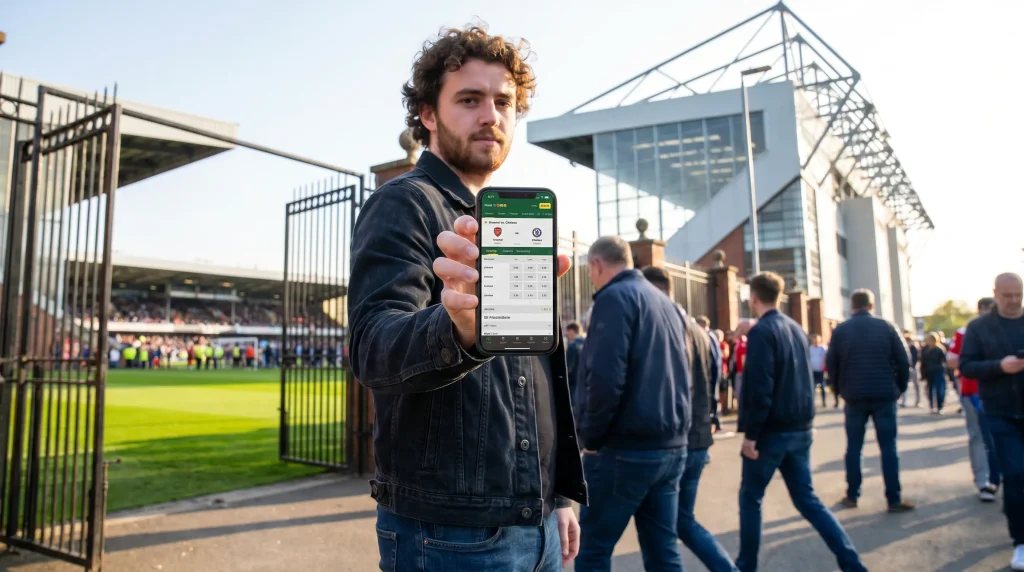
Navigate to the football section. You will see a list of fixtures, usually organised by league and kick-off time. Tap on the match you want to bet on. The main markets — match result, BTTS, over/under — appear immediately. Tap the price you want to back. It will be added to your bet slip, which appears at the bottom of the screen or in a sidebar on desktop.
Enter your stake — the amount of money you want to bet. The bet slip will show your potential return: stake multiplied by the decimal odds. If you are betting £5 at odds of 2.00, your potential return is £10, of which £5 is your original stake and £5 is profit. Review the selection, confirm the stake is what you intended, and press “Place Bet.” The bet is now live and will be settled after the match finishes.
A few practical tips for your first bets. Keep the stakes small — £2 to £5 per bet while you are learning. Bet on matches you can watch, so you can connect the market mechanics with what happens on the pitch. Stick to single bets rather than accumulators until you understand how individual markets work. And record every bet you place — the selection, the odds, the stake, and the result. That record is the single most valuable tool for improving your betting over time, more useful than any tipster or prediction site. For a deeper understanding of how the odds themselves work, the odds explained guide breaks down fractional, decimal and implied probability in detail.

What is the minimum age to bet on football in the UK?
You must be 18 or over to place a football bet in the UK, whether online or in a high-street bookmaker. This is a legal requirement enforced by the UK Gambling Commission. Bookmakers verify your age during the account registration process using identity checks, and any account found to belong to an underage person will be closed and winnings voided.
What happens if a football match is postponed after I have placed a bet?
If a match is postponed before kick-off, most bookmakers void your bet and return the stake to your account. The specific rules vary by operator and are detailed in their terms and conditions. If the match is rescheduled and played within a specified window — often 24 to 48 hours — some bookmakers will keep the bet live. Always check the individual bookmaker"s postponement policy.
Articles
Prepared by the Football Bet Today editorial staff.
