
Weekend Football Tips — Saturday and Sunday Picks From the Data
 Available in US
The Weekend Window — More Fixtures, More Edges
Saturday morning at my desk looks the same every week: two monitors, a spreadsheet with 30-plus fixtures sorted by kick-off time, and a cup of tea going cold. The weekend is the biggest window in the football betting calendar, and it is also the most overwhelming. More fixtures mean more opportunities, but only if you have a system for filtering signal from noise.
The sheer volume of weekend football across the UK is staggering. Roughly 290 million online bets on real events are placed every month in the UK market, and a disproportionate share of that volume lands on Saturday and Sunday fixtures. Premier League, Championship, League One, League Two, the Scottish Premiership, plus European leagues kicking off across the afternoon — a typical Saturday delivers 40 to 60 matches that a UK punter might reasonably bet on. Nobody can analyse all of them properly. The skill is in choosing which ones to focus on and ignoring the rest.

I have a rule that has served me well for years: never bet on a match I have not personally reviewed the data for. That sounds obvious, but on a Saturday with 50 fixtures the temptation to add a “looks good” leg to your coupon is enormous. Resist it. Every unresearched selection is negative expected value by default, because you are relying on intuition in a market priced by algorithms.
Saturday 3pm Kick-Offs — How to Process a Full Slate
The 3pm Saturday blackout means you cannot watch these matches live on UK television, but you can bet on them. That creates an interesting dynamic — the market prices are based entirely on pre-match data, and there is no live-viewing bias influencing the public money. For a data-driven punter, this is actually an advantage.
My Saturday workflow starts on Thursday evening. I pull the fixture list and run each match through my model, which weights recent form, xG data, home-away splits and any confirmed team news. By Friday morning I have a ranked list of matches ordered by the size of the discrepancy between my model’s probability and the bookmaker’s implied probability. The top five to eight matches go onto a shortlist for deeper review. The rest get deleted from the spreadsheet entirely — out of sight, out of temptation.
Friday evening is when I check team news. Championship and lower-league managers tend to confirm their squads later than Premier League managers, so Friday night and Saturday morning are when critical information drops. A key absence — a first-choice goalkeeper, a central midfielder who controls tempo — can shift my model’s output by several percentage points. If the market has not adjusted by Saturday morning, that is where the edge sits. With 95% of UK online gambling happening from home, the Saturday morning window between team news and kick-off is when thousands of punters are making the same decisions. Moving early on confirmed news is a genuine advantage.

One practical tip: I separate my Saturday bets into early decisions and late decisions. Early decisions are matches where my model shows clear value regardless of minor team-news variations — typically matches where the edge is 8% or more. These go on the slip by Friday night. Late decisions are matches where value depends on specific team news. These wait until Saturday morning confirmation.
Sunday Fixtures — Smaller Slate, Sharper Focus
Sundays offer a different tempo entirely. Where Saturday is a sprint through a packed schedule, Sunday is a sniper’s day — fewer fixtures, more time per match, and often higher-profile games that attract heavier public money.

The Premier League typically schedules one or two matches on Sunday, often at 2pm and 4:30pm. These are the most-watched, most-bet-on fixtures of the weekend. The pricing is razor-sharp because bookmakers know the volume is coming and they have had an extra day to fine-tune their models. Finding value in Sunday Premier League fixtures is harder than finding it in the Saturday 3pm slate, and I adjust my expectations accordingly. I might place five or six bets on Saturday and none on Sunday if the numbers do not line up.
Where Sunday does offer opportunity is in European leagues. La Liga, Serie A and Bundesliga fixtures that kick off on Sunday afternoon are priced with less precision by UK bookmakers than domestic matches. The data is available — xG, form tables, injury lists — but the UK market focuses its sharpest attention on English football. If you are willing to put the same level of research into a Sunday Bundesliga fixture that you put into a Saturday Championship match, the edges can be just as real.
Building a Weekend Coupon Efficiently
I used to build my weekend coupon the way most people do — scrolling through fixtures, picking the ones that “felt right,” and bundling them into an accumulator. My records from that era show exactly what you would expect: sporadic wins, consistent losses, and a slowly declining bankroll.
Now I build my weekend coupon in reverse. I start with the bankroll allocation — how much am I willing to stake this weekend in total? That number is fixed before I look at a single fixture. Then I distribute that allocation across the selections my model has flagged, weighted by conviction level. High-conviction singles get the largest share. Lower-conviction selections might go into a small accumulator or get dropped entirely.
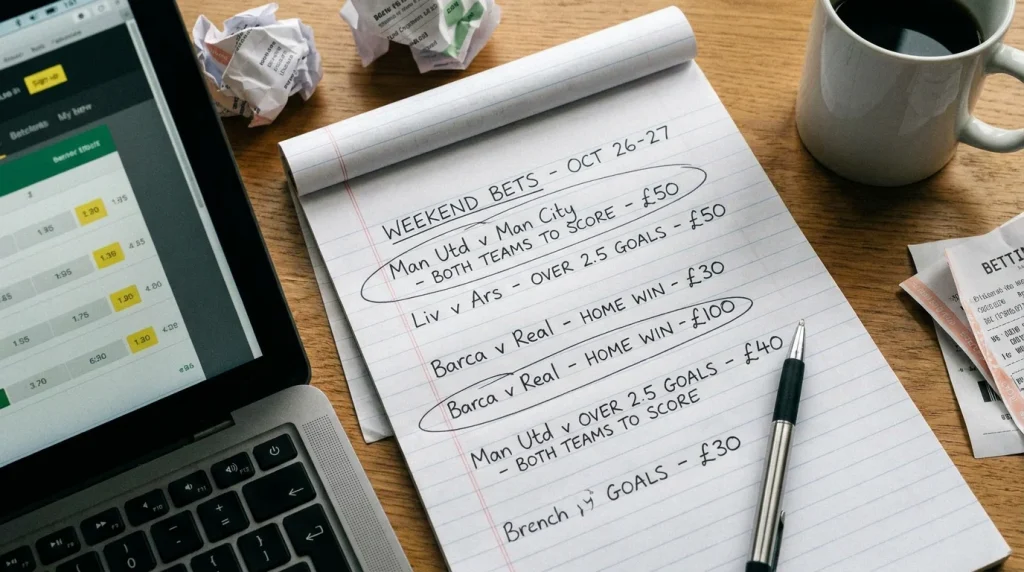
Nearly one in ten UK adults places a sports bet at least once a month, and among those who bet on sports, 87% of men reported placing a bet in 2025. The weekend is when most of that activity concentrates. The public money tends to flow toward favourites, accumulators and headline matches. That creates a systematic pattern: favourites in high-profile fixtures are often overbet, compressing their odds below fair value, while less glamorous matches — a League Two fixture between mid-table sides, a Scottish Championship match with no narrative hook — are underbet and sometimes mispriced. My weekend coupon leans into the latter category. Boring matches make profitable bets.

If you want to structure weekend accumulators more rigorously, the accumulator tips guide breaks down correlation analysis and leg selection in detail.
Is Saturday or Sunday generally better for football betting value?
Saturday offers more opportunities because the fixture volume is higher and the 3pm blackout slate contains matches with less public scrutiny. Sunday fixtures, particularly Premier League matches, attract heavier betting volume and sharper pricing, making value harder to find. The best approach is to treat them as separate exercises rather than a single weekend block.
How does having more simultaneous kick-offs affect bookmaker pricing?
When 15 or more matches kick off at 3pm, bookmakers spread their risk-management attention across a wider slate. Individual match pricing receives less manual oversight than a standalone Sunday fixture would. This creates small but exploitable inefficiencies, particularly in lower-league markets where automated models carry more weight than human traders.
Articles
Published by the Football Bet Today team.
