
Football Value Bets Today — Finding Overlays the Market Missed
 Available in US
Value Is the Only Edge That Compounds
Three years into my betting career I tracked every bet I had placed over a full season — 842 selections across all markets. My strike rate was 51%. Respectable, you might think. The problem was that 51% at average odds of 1.85 produced a net loss. I was picking more winners than losers and still bleeding money. That was the moment I stopped thinking about winners and started thinking about value.
Value betting is not about predicting which team wins. It is about finding situations where the bookmaker’s price implies a lower probability than what you believe the true probability to be. Sports betting accounts for 57.1% of all UK online gambling revenue, which means bookmakers are extremely good at pricing football markets. But “extremely good” is not the same as perfect, and the gaps between their prices and reality — however small — are the only sustainable edge available to a punter.
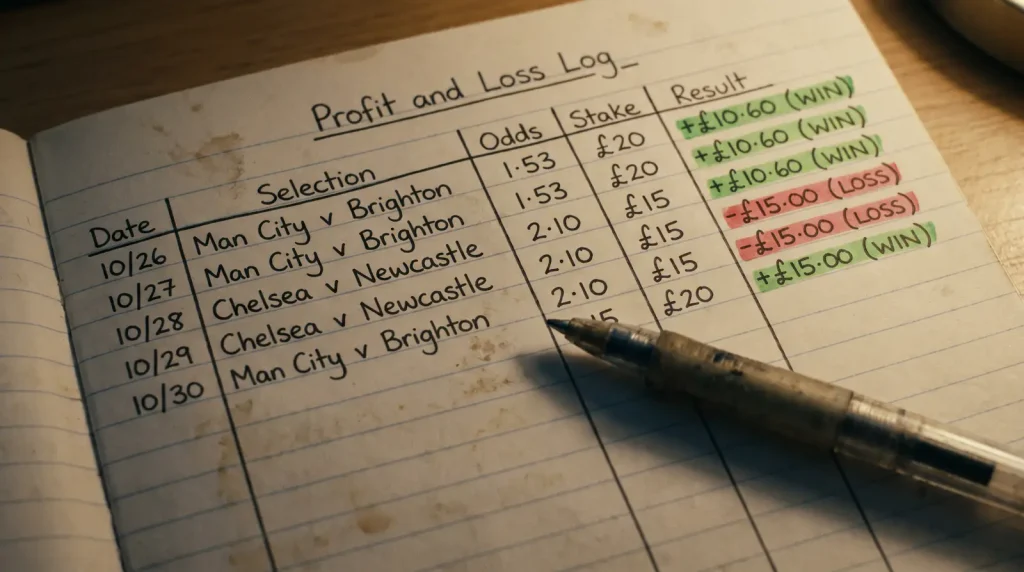
The concept scales. A single value bet might lose. Ten value bets might show a loss. But across hundreds and thousands of bets, positive expected value grinds out profit with the same inevitability that a casino’s house edge grinds out profit against players. The difference is that you are the one with the edge, not the house. Everything else — accumulator strategies, tipster selections, match previews — is decoration unless it is built on this foundation.
From Odds to Implied Probability — the Core Formula
Before you can spot value, you need to speak the bookmaker’s language. Every price on a football market is an implied probability wearing a disguise. Strip off the disguise and you see what the bookmaker thinks the real chance of an outcome is — minus their margin.
The conversion is simple. For decimal odds, divide 1 by the odds. A price of 2.50 implies a probability of 1 / 2.50 = 0.40, or 40%. For fractional odds, the formula is denominator / (denominator + numerator). So 6/4 becomes 4 / (4 + 6) = 0.40, the same 40%. If you want a deeper walkthrough of how fractional and decimal formats relate, the odds explained guide covers the mechanics in full.
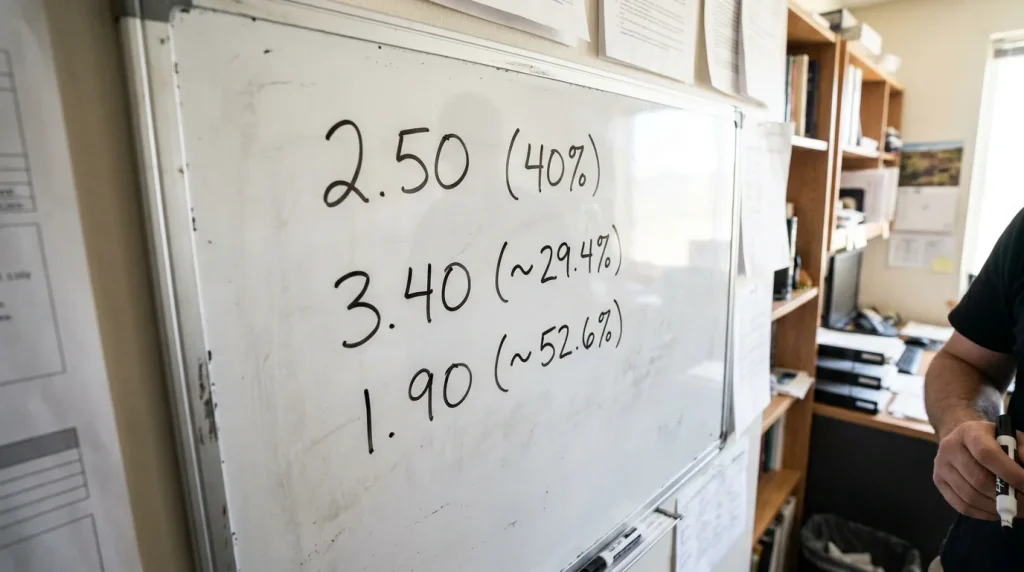
Now here is the catch. Add up the implied probabilities for all outcomes in a market and they will not sum to 100%. They will sum to something like 105%, 108%, sometimes 112% or more on exotic markets. That excess is the overround — the bookmaker’s built-in margin. It means every implied probability is slightly inflated relative to the true probability. A 40% implied probability in a market with a 106% overround might correspond to a true probability of about 37.7% once you strip out the margin. Understanding this distinction is critical because your value calculation must compare your estimated probability against the margin-adjusted implied probability, not the raw one.
To remove the margin, divide each outcome’s implied probability by the total overround. If the three outcomes in a 1X2 market imply 42%, 28% and 36% — totalling 106% — the margin-stripped probabilities become 39.6%, 26.4% and 34.0%. Those are the bookmaker’s real estimates.
Calculating Your Edge — Step by Step
I was sitting in a cafe in Manchester two winters ago, running numbers on a Championship fixture. My model gave the home win a 48% probability. The bookmaker’s margin-stripped implied probability was 41%. That is a 7 percentage point edge — large enough to act on.
The formula for expected value is straightforward: EV = (Your Probability x Decimal Odds) – 1. If my probability is 0.48 and the decimal odds are 2.40, the expected value is (0.48 x 2.40) – 1 = 0.152, or +15.2%. A positive number means value exists. A negative number means the bookmaker has the edge, and you should walk away.

The quality of this calculation depends entirely on the quality of your probability estimate. Garbage in, garbage out. I derive my estimates from a mix of expected goals data, recent form adjusted for opponent strength, home-away splits and — where relevant — injury and suspension news. The model is not complicated. It is a weighted average of inputs, not a neural network. What matters is that I trust the inputs and I have tested the model against historical data to confirm it produces calibrated probabilities over large samples.
One detail that has become increasingly important: the Remote Gaming Duty was increased to 40% from April 2026, with a new 25% remote betting duty arriving in April 2027. The government itself expects operators to pass up to 90% of that increase onto consumers. That means bookmaker margins are widening, overrounds are creeping up, and the implied probabilities embedded in prices are drifting further from true probabilities. For value bettors, this is a double-edged development. Tighter odds reduce the frequency of value opportunities, but the ones that remain carry larger edges because the market is less efficient at the margins.
Where Value Hides in UK Football Markets
Not all markets are created equal when it comes to finding overlays. Premier League match result markets are the most liquid, the most scrutinised and the hardest to beat. The bookmaker’s models are sharpest here because the data is deepest and the betting volume is highest. If you are hunting value exclusively in Premier League 1X2 markets, you are competing against the smartest pricing algorithms in the industry.
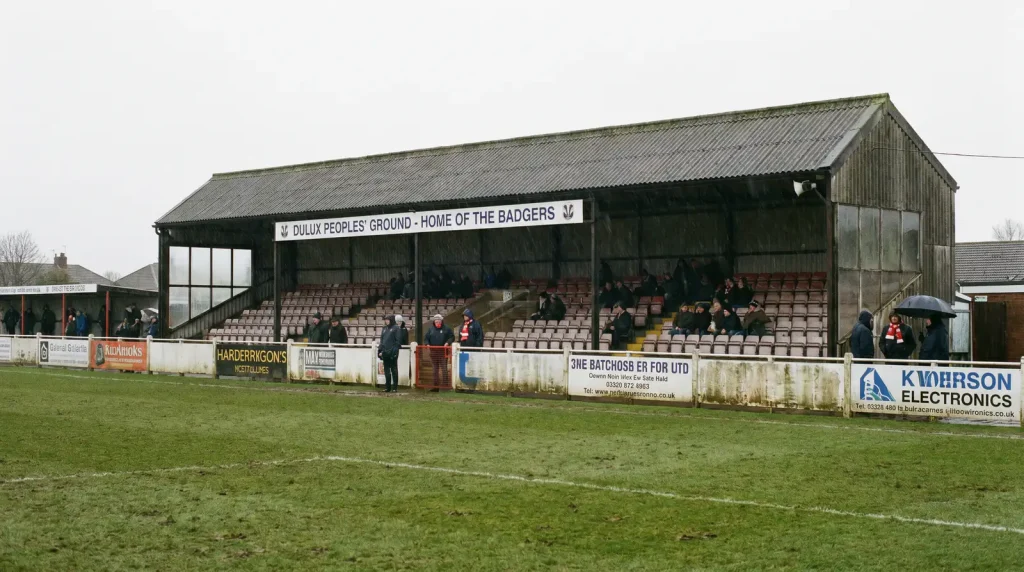
I find more consistent edges in three areas. First, lower-league English football — League One, League Two, and the National League — where bookmaker models rely on thinner data and the pricing is less precise. Second, peripheral markets within well-covered fixtures: corners totals, booking points, and player shot markets where the pricing models are secondary priorities for the bookmaker’s trading desk. Third, early-week lines before the market has fully adjusted to team news and training reports.
Helen Rhodes, Director of Major Policy Projects at the UK Gambling Commission, has noted that much of the public commentary around financial risk assessments has been inaccurate — and the same applies to how punters perceive bookmaker pricing. Many assume the price they see is a precise reflection of true probability. It is not. It is a commercial product designed to balance the bookmaker’s book and generate margin. The gap between that commercial product and actual probability is where your edge lives.
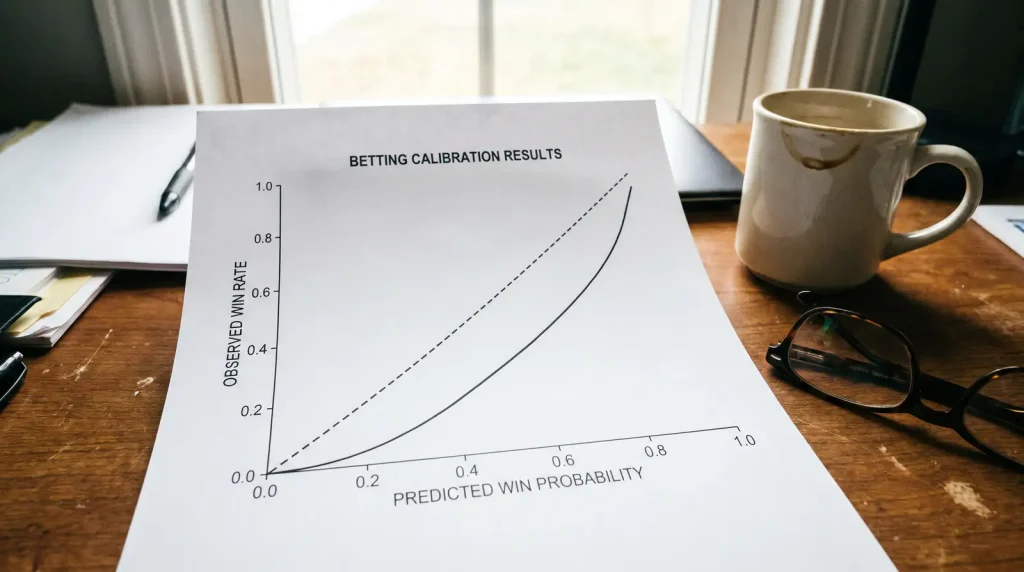
A practical habit that has served me well: keep a spreadsheet logging every value bet with your estimated probability, the bookmaker’s price, and the outcome. After 200-300 bets, chart your calibration — do selections you rated at 50% win roughly half the time? Do your 30% estimates land about 30% of the time? If so, your model is calibrated and the positive expected value will show in your returns. If not, the model needs adjustment before you stake another pound on it.
What percentage edge makes a football bet worth placing?
I look for a minimum edge of 5% on singles and 8-10% on higher-variance markets like correct score. Anything below 5% is too easily eroded by the bookmaker"s overround and the inherent noise in probability estimation. The larger the edge, the smaller the sample you need before it shows in your returns.
How does bookmaker margin affect value identification?
Bookmaker margin inflates every implied probability in a market. If you compare your estimate against raw implied probability without stripping out the margin, you will systematically overestimate the frequency of value bets. Always divide each outcome"s implied probability by the total overround before comparing against your own estimate.
Can value bets still lose more often than they win?
Absolutely. A selection with a true 35% probability and an edge of 8% still loses 65% of the time. Value betting is about long-run expected profit, not short-run win rate. You need disciplined staking and a large enough sample — typically 300+ bets — before variance smooths out and the edge becomes visible in your actual returns.
Articles
Published by the Football Bet Today team.
