
Anytime Goalscorer Tips Today — How to Find Value in the Most Popular Player Market
 Available in US
Anytime Goalscorer — Where Volume Meets Mispricing
I spent three months in 2019 tracking every anytime goalscorer bet I placed — 214 selections across the Premier League, Championship and League One. My strike rate was 29%. Sounds low until you consider that the average implied probability on those selections was 22%. That 7 percentage point gap, sustained across 214 bets at average odds of 3.80, produced a 19% return on investment. The anytime goalscorer market is not glamorous. It will not make you rich overnight. But it is one of the most reliably mispriced player-level markets in UK football betting, and the data to exploit it is freely available.
Football is the UK’s most popular betting sport — 5.8% of the population places football bets — and anytime goalscorer is one of the first markets new punters discover. The appeal is simple: pick a player, hope he scores at any point during the match, collect at odds of 2.50 to 8.00 depending on the player. That simplicity drives massive volume, with roughly 290 million online bets placed monthly across UK sports markets, a significant share landing on goalscorer markets. The volume creates liquidity, the liquidity creates competitive pricing, and within that competitive pricing sit pockets of genuine value for anyone willing to look past the obvious names.
Why Anytime Goalscorer Differs From First Goalscorer
A mate once asked me why he should bother with anytime goalscorer when first goalscorer pays more. Fair question, wrong framing. The two markets reward different analytical approaches and carry different risk profiles, and conflating them is one of the most common mistakes in player-market betting.
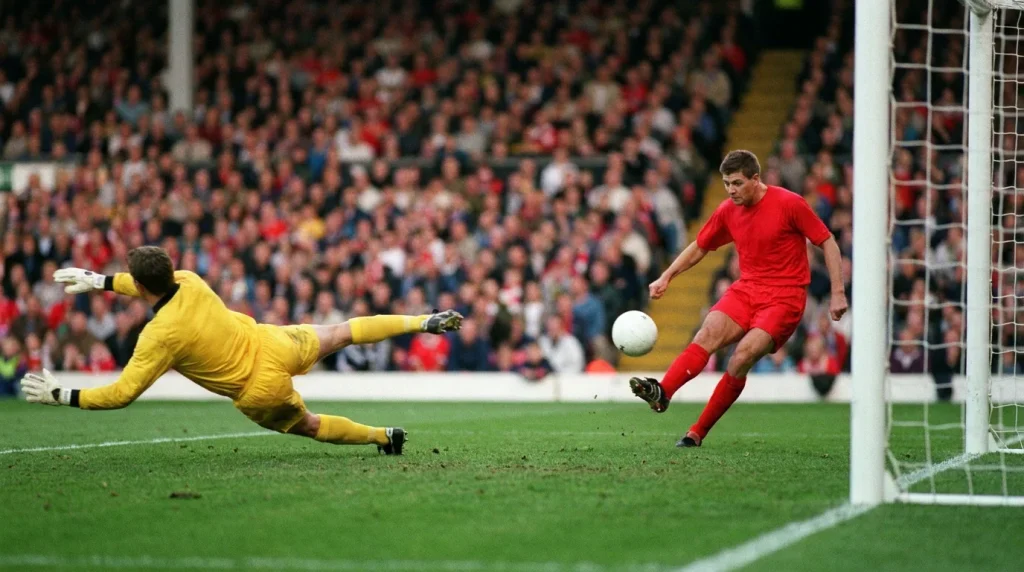
First goalscorer is a high-variance, low-probability bet where a single moment — the opening goal — determines the outcome. A player who comes off the bench at 60 minutes has almost no chance of winning your first goalscorer bet even if he scores a hat-trick between the 70th and 90th minutes. Anytime goalscorer removes that constraint entirely. Every minute counts. A substitute who enters at half-time and scores in the 88th minute wins your bet just as decisively as a starter who scores in the 3rd minute.
The practical implication is that anytime goalscorer rewards total goal probability across the full match, not just the opening phase. That shifts the analytical focus from “who is likely to score first” to “who is most likely to score at all.” The distinction matters because the factors that predict first goals — set-piece involvement in the opening 20 minutes, starting XI confirmation — are different from the factors that predict goals at any point — total xG per 90 minutes, minutes played, penalty duties, and substitution patterns.
The overround on anytime goalscorer markets is typically lower than on first goalscorer — around 120-140% versus 150-180% — because there are fewer possible outcomes per player. That tighter margin means less of your edge is eaten by the bookmaker’s cut, making the market structurally friendlier for value bettors.
The Three Metrics That Drive Goalscoring Probability
Every anytime goalscorer model I have built comes down to three inputs. They are not secret. They are not complicated. But combining them correctly, rather than eyeballing team sheets and guessing, is what separates a profitable approach from an expensive hobby.
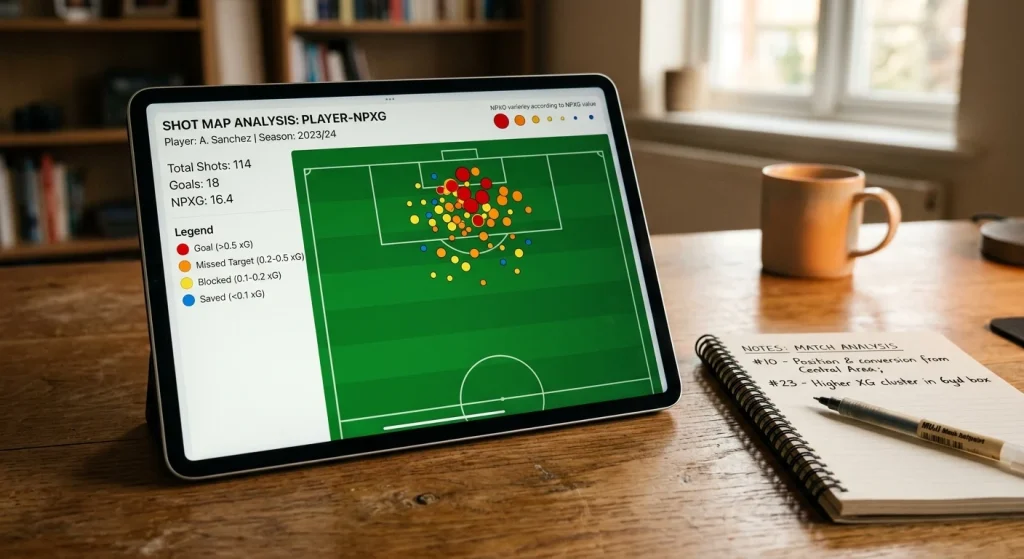
First: non-penalty expected goals per 90 minutes, or npxG/90. This strips out penalties to give you the player’s goal threat from open play and set pieces alone. A forward with 0.55 npxG/90 is creating dangerous chances at a rate that will produce goals over any reasonable sample. A midfielder sitting at 0.15 npxG/90 is not a realistic goalscorer unless he is also on penalty duty. I set a minimum threshold of 0.25 npxG/90 for any player to enter my anytime goalscorer shortlist.
Second: penalty responsibility. This is the single largest edge accelerator in the market. A confirmed penalty taker on a team that wins penalties frequently adds 0.08 to 0.15 expected goals per match to his baseline, depending on the team’s penalty-winning rate. That addition often pushes a player’s true goal probability above the bookmaker’s implied probability by several percentage points. Online platforms account for 78.47% of UK sports betting revenue, and the penalty data available through those platforms is comprehensive — penalty-winning frequency by team, conversion rates by taker, and fouls-in-the-box conceded by opponent.

Third: expected minutes. A player who starts every match averages 85-90 minutes. A rotation risk averages 60-70 minutes. A regular substitute averages 20-30 minutes. The relationship between minutes and goal probability is roughly linear — halving the minutes roughly halves the goal probability. I adjust every player’s npxG/90 figure by their expected minutes share before comparing against the bookmaker’s price. A player with elite npxG/90 but a 50% chance of starting is worth significantly less than his headline statistics suggest.
Rotation, Substitution Patterns and Late-Goal Angles
There is a specific scenario that has produced some of my best anytime goalscorer returns over the years, and it involves players most punters overlook: the reliable substitute.
Certain forwards — typically ageing strikers or young prospects being managed carefully — are brought on regularly between the 55th and 70th minute. They enter the match fresh, against tired defenders, often with the team chasing a goal or protecting a lead that invites counter-attacks. Their npxG/90 when entering as a substitute can exceed their npxG/90 as a starter, because the game state favours them. Yet bookmakers price their anytime goalscorer odds based on their overall season statistics, which blend starting and substitute appearances into a single average. The result is a systematic underpricing of their goal probability in matches where they are likely to come off the bench.

I track substitution patterns by manager and by match context. A manager who consistently brings on the same forward in the 60th minute when chasing a game is giving me a predictable entry point. If that forward has a strong npxG/90 in substitute appearances and the upcoming fixture is likely to produce a game state where he enters — the team is away to a side that tends to lead at half-time, for instance — the anytime goalscorer price is often too long.
The broader point is that anytime goalscorer rewards patience and specificity. The market is not about picking the best striker in the league at whatever price the bookmaker offers. It is about finding the specific player-fixture combination where the true goal probability exceeds the implied probability by enough to generate positive expected value. Tim Miller at the Gambling Commission has emphasised the importance of informed decision-making for punters — and in the anytime goalscorer market, informed means data-driven, not gut-driven. If you want to understand how the first goalscorer market handles these same dynamics differently, the first goalscorer guide covers the opening-goal angle in detail.
How does anytime goalscorer differ from first goalscorer in terms of value?
Anytime goalscorer rewards total goal probability across the full 90 minutes, while first goalscorer depends on scoring the opening goal specifically. Anytime goalscorer markets carry lower overrounds — typically 120-140% versus 150-180% — meaning less of your edge is consumed by the bookmaker"s margin. The analytical focus shifts from set-piece involvement in the opening phase to overall npxG/90, penalty duties and expected minutes.
Why are substitute players sometimes underpriced in anytime goalscorer markets?
Bookmakers price anytime goalscorer based on a player"s overall season statistics, which average starting and substitute appearances together. A forward who enters as a substitute between the 55th and 70th minute often has higher npxG/90 in those appearances because he is fresh against tired defenders in favourable game states. That context-specific advantage is not captured in the blended average, creating a systematic underpricing.
Articles
Written by the editors at Football Bet Today.
