
Asian Handicap Betting in Football — From Quarter-Lines to Full Goals
 Available in US
Why Asian Handicaps Exist — Levelling the Match
The first time I looked at an Asian handicap market I closed the tab. The numbers made no sense — minus 0.75, plus 1.25, half-goals that cannot exist in football. It took a patient explanation from a more experienced punter and about 20 practice bets before the logic clicked. Now Asian handicaps are my most-used market, and I think every serious football bettor in the UK is leaving money on the table by ignoring them.
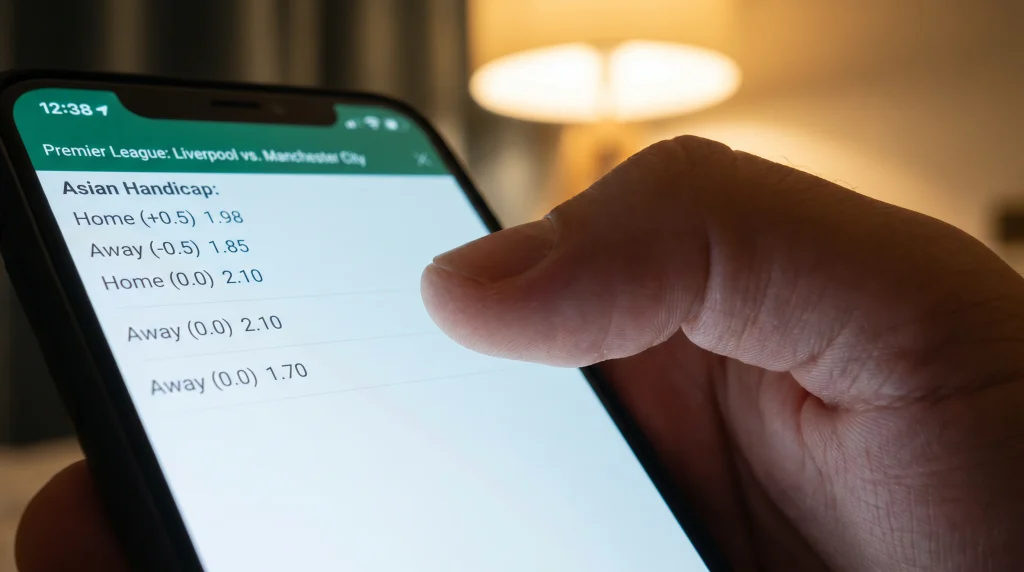
The fundamental problem Asian handicaps solve is simple: most football matches have a favourite. In the standard 1X2 market, that favourite is priced at short odds — sometimes very short. A home win at 1.20 offers almost no return and still carries risk because draws and upsets happen. Sports betting accounts for 57.1% of UK online gambling revenue, yet the vast majority of that volume sits in 1X2 markets where the pricing on heavy favourites is compressed and the draw option absorbs a disproportionate share of the overround. Asian handicaps eliminate the draw entirely and level the contest by giving one team a virtual head start, creating a two-outcome market with tighter margins and more nuanced pricing.
Half-Goal, Quarter-Goal and Full-Goal Lines Explained
The half-goal handicap is the simplest. If you back a team at -0.5 on the Asian handicap, they need to win the match for your bet to succeed. A draw or a loss means the bet loses. This is functionally identical to backing the team to win on the 1X2 market, but — and this is critical — the odds are different because there is no draw option absorbing margin. The price on -0.5 Asian handicap is typically better than the equivalent 1X2 match result price for a home or away win.
Full-goal handicaps introduce the possibility of a void bet. At -1.0, the team needs to win by two or more goals for the bet to win. If they win by exactly one goal, the handicap result is a tie and your stake is refunded in full. If they draw or lose, the bet loses. This refund mechanism is the defining feature of full-goal Asian handicaps and it creates a fundamentally different risk-reward profile from European handicap markets where a one-goal win at -1 simply loses.
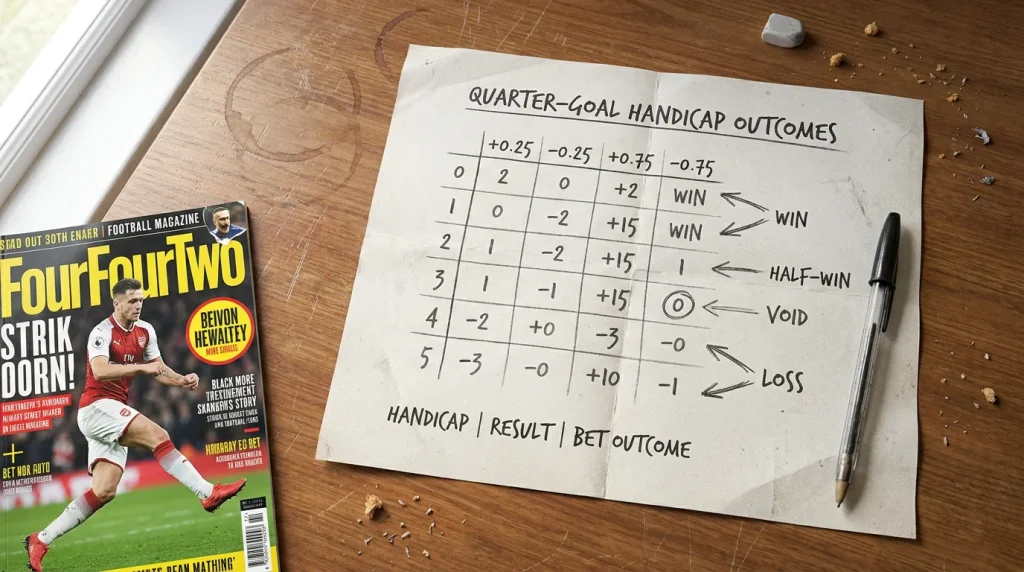
Quarter-goal lines are where most people’s heads start to spin, but the mechanism is logical once you see it. A -0.75 handicap is actually two half-bets combined: half your stake goes on -0.5 and half goes on -1.0. If the team wins by exactly one goal, the -0.5 half wins and the -1.0 half is voided — you get a half-win, half-refund. If they win by two or more, both halves win. If they draw or lose, both halves lose. The same logic applies to +0.25, +0.75, -1.25 and every other quarter-line. They split your stake across two adjacent half-goal lines.
I find quarter-lines particularly useful because they allow precise positioning. If my model suggests a team should be a 1.2-goal favourite but the -1.0 line offers poor value and the -1.5 line is too aggressive, the -1.25 line lets me sit in between with half-protection on the smaller margin.
When Asian Handicap Beats the 1X2 Market
Not every match warrants an Asian handicap bet. The market is most valuable in three specific scenarios.
First, heavy-favourite matches. When a team is priced at 1.25 or shorter on the 1X2, the match result market offers terrible risk-reward. The Asian handicap lets you take that same favourite at -1.5 or -2.0, where the odds lengthen to 2.00 or higher and the payout justifies the risk. In-play betting now accounts for more than 70% of UK sports wagers, and during live matches involving heavy favourites the Asian handicap lines shift faster and more precisely than the 1X2, creating more frequent entry points for value.

Second, matches where you want to back the underdog but are not confident they can win outright. A +0.5 Asian handicap on the away team wins if they draw or win — effectively giving you two of the three 1X2 outcomes in a single bet. The odds are shorter than a straight away win, but the probability of collecting is much higher, and the price is often better than the equivalent draw-no-bet option.
Third, matches with a clear form disparity that the market has acknowledged but not fully priced. If a top-six side is away to a bottom-three side, the 1X2 market might price the away win at 1.55, which implies roughly 65% probability. My model might say 70%. On the 1X2, that 5% edge exists but the price is short. On the -1.0 Asian handicap at 2.20, the same edge translates into much better odds because the handicap market distributes margin differently across the line.
Tighter Margins — Why Handicap Markets Often Offer Better Value
The structural advantage of Asian handicaps for punters comes down to margin. A typical 1X2 market on a Premier League match carries an overround of 103-106%. The equivalent Asian handicap market on the same match typically carries an overround of 101-103%. That difference — 2 to 4 percentage points — might sound small, but across 500 bets in a season it represents a significant saving in margin cost.
The reason is competition. Asian handicap markets originated in Asian betting exchanges where sophisticated bettors demand tight pricing. UK bookmakers who offer Asian handicaps are competing not just with each other but with Asian operators who set the global benchmark for handicap pricing. That competitive pressure keeps margins tight in a way that the more recreational-friendly 1X2 market does not experience.
I compare the effective margin on both markets before every bet. Sometimes the 1X2 is tighter — particularly on high-profile matches where bookmakers use the 1X2 as a loss-leader to attract customers. But on lower-profile fixtures — midweek Championship matches, League One Saturday games, European fixtures outside the top four leagues — the Asian handicap margin is almost always tighter. For those fixtures, betting the handicap market instead of the 1X2 is essentially getting a free margin reduction on every selection. For a broader look at how odds formats and margins work across different market types, the odds explained guide covers the mechanics in detail.

What happens to my bet if the Asian handicap result is exactly on the line?
If you are on a full-goal line (e.g. -1.0) and the handicap-adjusted result is exactly zero, your stake is refunded in full. This is called a void or push. On half-goal lines (-0.5, -1.5), a push is impossible because the half-goal ensures a definitive win or loss. On quarter-goal lines, half your stake may be voided while the other half wins or loses, depending on which of the two component lines lands on the exact margin.
Why are Asian handicap margins typically lower than match-result margins?
Asian handicap markets face competitive pressure from Asian betting exchanges and specialist operators who set global benchmarks for handicap pricing. UK bookmakers offering handicap markets must match that pricing to attract sophisticated bettors, which keeps overrounds tight. The 1X2 market, by contrast, caters primarily to recreational punters who are less price-sensitive, allowing bookmakers to maintain wider margins.
Articles
Created by the "Football Bet Today" editorial team.
