
In-Play Football Betting Tips — Disciplined Live Staking
 Available in US
70% of UK Sports Bets Are Now Placed In-Play
A decade ago, live betting was a novelty — a side feature buried in a bookmaker’s menu. Today, in-play wagers account for more than 70% of all online sports bets placed in the UK, up from less than 30% ten years ago. That shift has fundamentally changed how football is bet on and, crucially, how bookmakers manage their risk. If you are not thinking about in-play markets, you are ignoring where the majority of money now flows.
The appeal is obvious. You watch the match, you see a team dominating possession and creating chances, the odds on that team drift because they have not scored yet, and you back them at a bigger price than was available pre-match. It feels like you have an informational edge — you can see what is happening. The problem is that the bookmaker can see what is happening too, and their algorithms process live data faster than any human can. The odds you see on screen are not stale. They reflect shot counts, xG accumulation, ball progression, and a dozen other metrics updated in near-real time. Your visual impression of the match is already priced in.
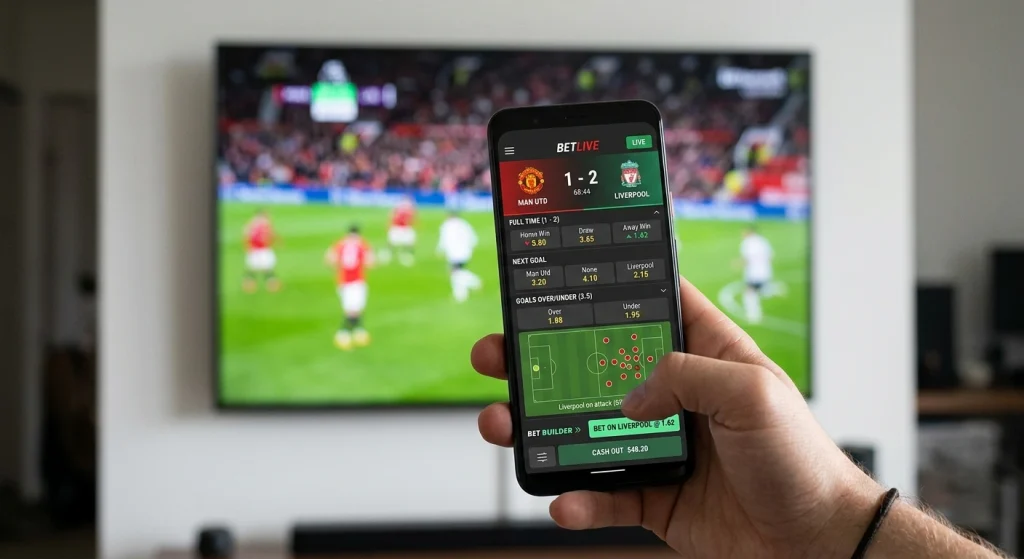
That does not mean in-play betting is unwinnable. It means the edge, when it exists, comes from discipline and preparation — not from reacting to what you see on the pitch in real time.
Data Triggers for Live Entry Points
I do not sit down to watch a match and decide mid-flow whether to place a bet. My in-play bets are pre-planned. Before kick-off, I identify specific scenarios that my model suggests are mispriced when they occur live, and I set price alerts or mental triggers for those scenarios.
The most reliable trigger I use is what I call the “dominant nil” — a team that is 0-0 at half-time but has accumulated significantly more xG than their opponent. My historical data shows that teams with 1.0+ xG and zero goals at half-time go on to win the match approximately 55-60% of the time. The live odds in that scenario typically price the dominant team’s win probability at 40-45%, because the market anchors on the current scoreline. That gap between the model and the market is the entry point.
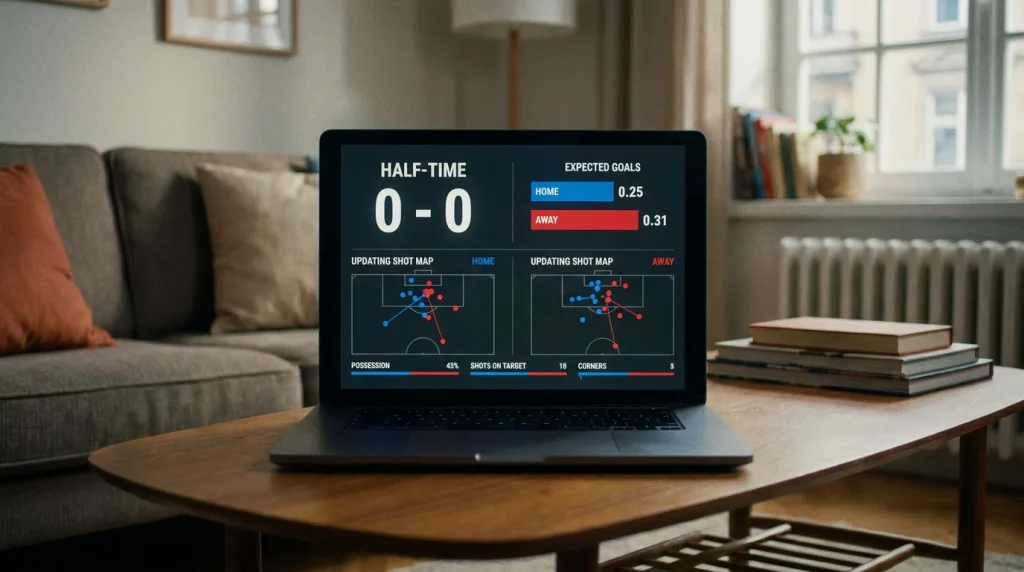
Another trigger is the early goal conceded by a pre-match favourite. When a strong team goes 0-1 down inside the first 20 minutes, the live odds on them to win the match spike dramatically. The public overreacts to the early deficit. My data shows that pre-match favourites who concede first before the 20th minute still win the match roughly 35-40% of the time in the Premier League. If the live odds imply a win probability below 30%, there is value in backing the comeback. Online platforms dominate UK sports betting with a 78.47% revenue share, and the speed of those platforms means the odds stabilise quickly — you have a narrow window of three to five minutes after a goal before the market fully adjusts.

What I avoid is chasing. If a trigger does not fire — if the match does not produce the scenario I pre-planned for — I do not bet. This is the hardest discipline in live betting, because the match is on your screen and the temptation to “find something” is constant.
Cash-Out Decisions — When the Maths Says Walk Away
Last March I had a pre-match bet on a home win at 2.10. By the 70th minute the home team was 1-0 up and the bookmaker offered a cash-out at 78% of the potential return. I took it. Three minutes later the away side equalised. That cash-out saved me from a losing bet, but the decision was not based on watching the match — it was based on the numbers.
Cash-out is a tool, not a panic button. Every cash-out offer is essentially a new bet — the bookmaker is offering you a guaranteed return in exchange for surrendering the remaining expected value of your position. Whether to accept depends on a simple comparison: is the guaranteed cash-out amount greater or less than the expected value of letting the bet ride?
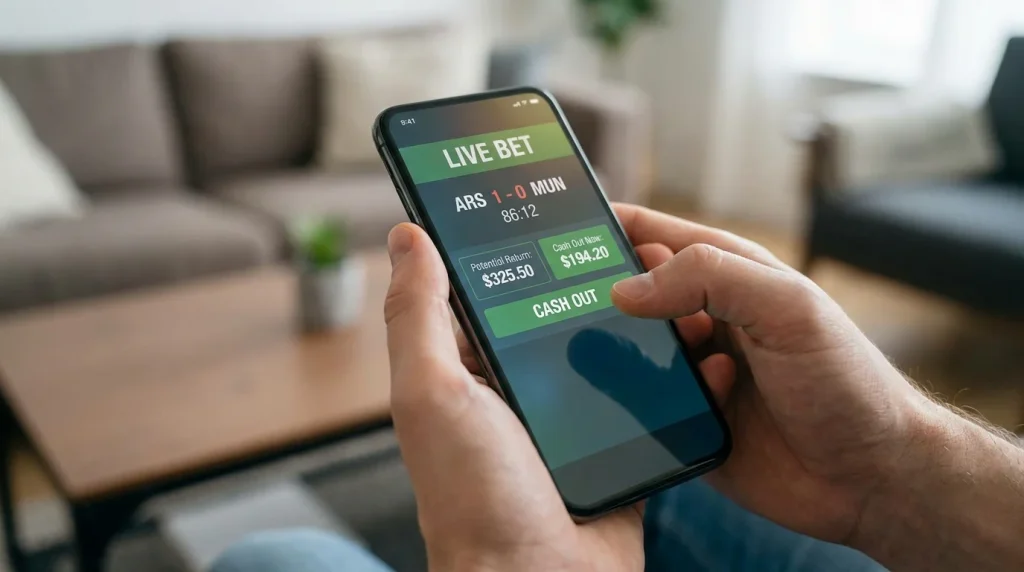
To calculate this, you need an estimate of your bet’s current win probability. If you have a match-result bet on the home team and they are leading 1-0 in the 75th minute, historical data gives the home team roughly an 85% chance of winning from that position. Your expected value of letting the bet ride is 0.85 times the full payout. If the cash-out offer exceeds that number, take it. If it does not, let it ride. Helen Rhodes at the Gambling Commission has pointed out that much commentary around financial assessments in betting is inaccurate, and the same applies to how punters evaluate cash-out offers — most accept or reject based on gut feeling rather than expected value calculation.
One caveat: bookmakers build a margin into the cash-out price. The offer is typically 5-10% below the mathematically fair value. This means that in most situations, declining the cash-out and letting the bet run is the higher-EV play. I only cash out when specific match conditions — a red card, a clear tactical shift, a key injury — have materially changed the probability beyond what the bookmaker’s algorithm has captured.
Staying Disciplined When the Match Is Moving Fast
The pace of live football triggers every cognitive shortcut your brain has. A goal changes the emotional landscape of the match in an instant. The crowd roars, the commentator’s pitch rises, and suddenly you are reaching for your phone to place a bet you did not plan 30 seconds ago. I have been there hundreds of times. The difference between profitable and unprofitable in-play punters is not analytical skill — it is impulse control.
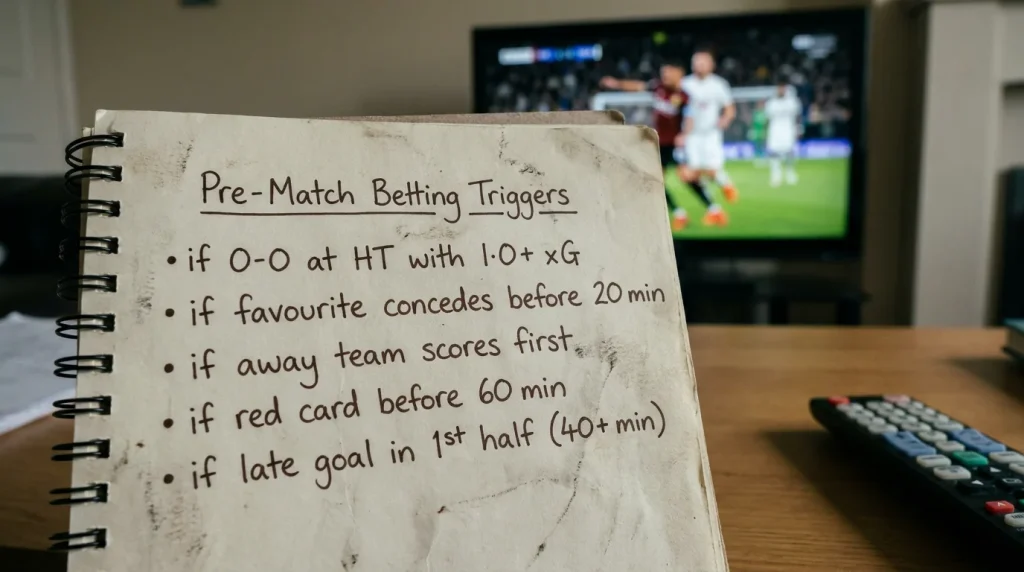
My approach is mechanical. I write down my pre-match triggers on a piece of paper before the match starts. If the match produces one of those triggers, I bet. If it does not, I watch as a fan and leave my betting account alone. I also set a per-match staking limit for in-play bets — never more than 2% of my bankroll on any single live bet, and never more than 5% across all in-play bets on a single matchday. These limits are non-negotiable, and they exist specifically because I know that my judgement degrades when the match is exciting.
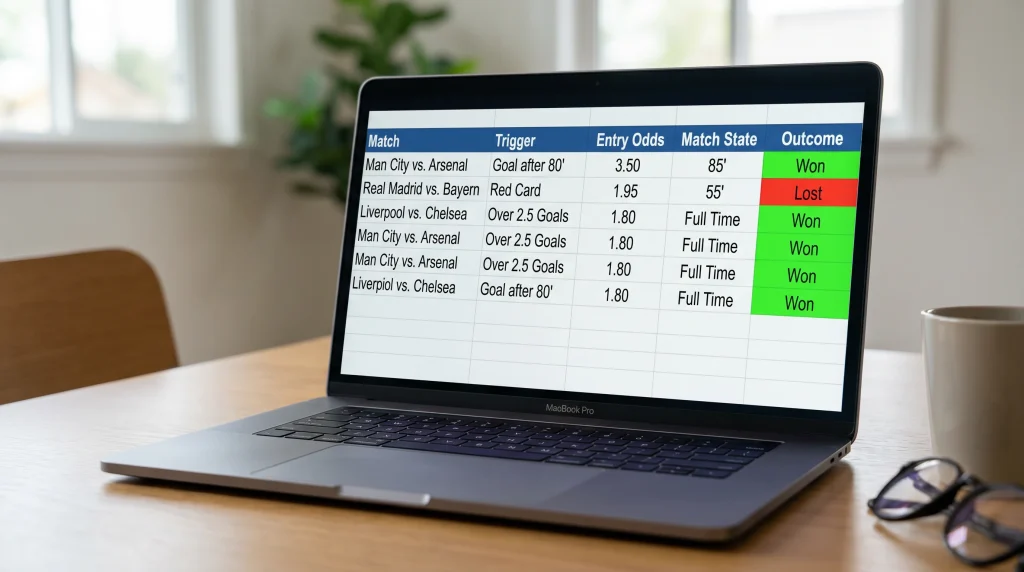
The other discipline is logging. Every in-play bet goes into a spreadsheet with the trigger that fired, the odds taken, the match state at the time of the bet, and the outcome. After 50-100 in-play bets, I review the triggers. Which ones are profitable? Which ones felt good but lost money? The data tells you what works far more reliably than your memory of individual matches. If in-play betting interests you but you are concerned about managing stakes under pressure, the bankroll management guide covers staking frameworks designed specifically for high-tempo betting environments.
What is the biggest risk of in-play football betting?
The biggest risk is impulsive staking driven by emotional reactions to match events. Live betting moves fast and triggers cognitive biases — recency bias after a goal, anchoring on the current scoreline, and the illusion of control from watching the match. Without pre-planned triggers and strict staking limits, most punters lose more in-play than pre-match because the speed of decision-making outpaces rational analysis.
What in-play data points should I monitor beyond the scoreline?
The most useful live data points are cumulative xG by team, shot counts inside the box, ball progression into the final third, and pressing intensity metrics. A team generating 1.2 xG while their opponent sits at 0.3 is dominating the match regardless of the scoreline. These metrics update in near-real time on several platforms and give a more accurate picture of match dynamics than the score alone.
Articles
Published by the Football Bet Today team.
