
Football Bet Builder Tips Today — Structuring Same-Game Multiples
 Available in US
Bet Builders Are Not Just Accumulators With a New Name
When bet builders first appeared on UK bookmaker platforms around 2018, I dismissed them as a gimmick — a flashy interface layered over the same overpriced combination bets the industry had always offered. I was wrong. After four years of tracking bet builder outcomes against traditional accas, I can say with confidence that same-game multiples are a genuinely different product — different in how they are priced, different in how correlation is handled, and different in where the edges hide.

The fundamental distinction is this: a traditional accumulator combines legs from separate matches, each priced independently. A bet builder combines legs from a single match and adjusts the combined price to account for the relationships between those legs. Online platforms now represent the largest betting channel in the UK with a 78.47% share of revenue, and bet builders have become one of the fastest-growing products within that channel because they let punters construct bespoke bets tailored to their analysis of a specific fixture.
That “adjustment for relationships” is the crucial part. When you combine match result, over 2.5 goals, and a player to score in the same bet builder, the bookmaker’s algorithm calculates a combined price that reflects the conditional probabilities — how the result outcome affects the goals outcome, how the goals outcome affects the scorer probability, and so on. In a traditional acca, you would get three independent prices multiplied together with no adjustment, which would overprice the combination relative to its true probability. The bet builder price should, in theory, be more accurate — and in most cases it is, which makes finding value harder but not impossible.
The opportunity lies in the algorithm’s imperfections. Bookmaker bet builder algorithms are proprietary and opaque, but they are not perfect. They model correlation between common leg types well — result and goals, for instance — but struggle with more exotic combinations where the historical data is thinner. Player props combined with corner markets, card markets combined with goalscorer bets, team shots on target combined with match result — these less common combinations are where the pricing model has fewer data points and the edge potential is highest.
Leg Types — Results, Goals, Cards, Corners and Player Props
I built my first serious bet builder around three leg types: match result, over/under goals, and a player to score. It landed, and I thought I had cracked the code. Then I spent the next six months repeating the same structure and watched my returns flatline as the pricing algorithm learned the exact same patterns I was exploiting. The lesson was clear: variety in leg types is not just creative — it is strategically necessary.
Match result and goals-related legs are the backbone of most bet builders, and they are also the most accurately priced. Bookmakers have decades of data on how these outcomes correlate, and their models handle them efficiently. I still include them — they anchor the bet — but I rarely build a bet builder with only result and goals legs, because the pricing on those combinations is tight.
Card markets are where I have found the most consistent edge. Booking points (10 for a yellow, 25 for a red) and player card legs are priced based on league-wide averages and individual player records, but the models struggle to account for match-specific factors: the referee appointment, the tactical style of both sides, and the history of ill-tempered encounters between the two clubs. I maintain a referee database with average cards per match, average fouls per match, and tendencies in specific fixture types (derby matches, relegation battles). This data — freely available from stats sites — gives me an informational edge that the bet builder algorithm does not fully capture. For a deeper look at how corner and card data feeds into bet builders, I have written a dedicated guide.

Corner legs are similarly undermodelled. Total match corners depend on tactical style — sides that press high and attack wide generate more corners than possession-dominant teams that recycle through the middle. A fixture between two wide-attacking, direct sides will produce more corners than the league average, but the bet builder algorithm prices corners based primarily on team averages without fully weighting the specific tactical interaction. I look for fixtures where both sides rank in the top eight for corners won per match and add an over-corners leg at a price that typically overestimates the difficulty.
Player props — shots on target, passes, tackles — have exploded in availability across UK platforms. Roughly 290 million online bets are placed monthly in the UK, and player-prop markets absorb a growing share of that volume. The pricing here is thinner than on match-level markets because the data models are newer and less refined. A player’s shots-on-target average over the season might be 1.8, but against a side that concedes the most shots inside the box in the league, the contextual probability of 2+ shots on target is significantly higher. The algorithm prices from the average; I price from the matchup.
Understanding Correlation Inside a Single Match
If I had to name the single concept that separates profitable bet builder punters from losing ones, it is understanding intra-match correlation — how the legs inside your bet builder relate to each other in ways the algorithm may or may not account for.
Some correlations are obvious. If you combine Home Win with Over 2.5 Goals, both legs benefit from the same scenario: the home side scoring multiple times in a dominant display. The algorithm prices this relationship reasonably well. But the correlation between less common leg combinations is where things get interesting — and potentially profitable.
Take this example: you combine “Player X to have 2+ shots on target” with “Over 9.5 total match corners.” On the surface, these seem unrelated. But consider: if a match is producing lots of corners, both sides are likely attacking frequently and getting into the final third, which means more shots. And if Player X is a forward or attacking midfielder, more attacking pressure means more shooting opportunities. The correlation is positive but indirect, and most bet builder algorithms underweight these second-order relationships. The combined price is longer than the true combined probability, which is exactly where you want to be.
Negative correlation within a bet builder is the trap to avoid. Combining “Under 1.5 goals” with “Player X anytime goalscorer” creates a contradiction: you need goals for the scorer leg but need few goals for the unders leg. The algorithm will price this, but the resulting price is often poor value because the two scenarios you are betting on barely overlap. I have a simple rule: before finalising any bet builder, I ask “what match scenario makes all these legs win simultaneously?” If I cannot describe a single coherent scenario, the bet builder has internal contradictions and I scrap it.

One of my most successful bet builder templates exploits positive correlation between aggressive tactical matchups. When two high-pressing sides meet, the match tends to be open, transitional, and chaotic. In that scenario, multiple outcomes cluster together: over 2.5 goals, both teams scoring, high corners, high fouls (and therefore cards), and forwards getting multiple shots. I build a five or six-leg bet builder around this cluster, and the combined price is typically 15-25% longer than my estimated true probability because the algorithm prices each leg with only partial adjustment for the scenario I am targeting.
How Bookmakers Price Bet Builders — and Where Edges Hide
I reverse-engineered a bookmaker’s bet builder pricing last spring by placing identical combinations across three platforms and comparing the offered odds. The variation was revealing: the same three-leg combination — home win, over 2.5 goals, a named player to score — was priced at 4.50 on one platform, 5.00 on another, and 5.50 on a third. That 22% price range on an identical bet tells you everything about where edges exist.
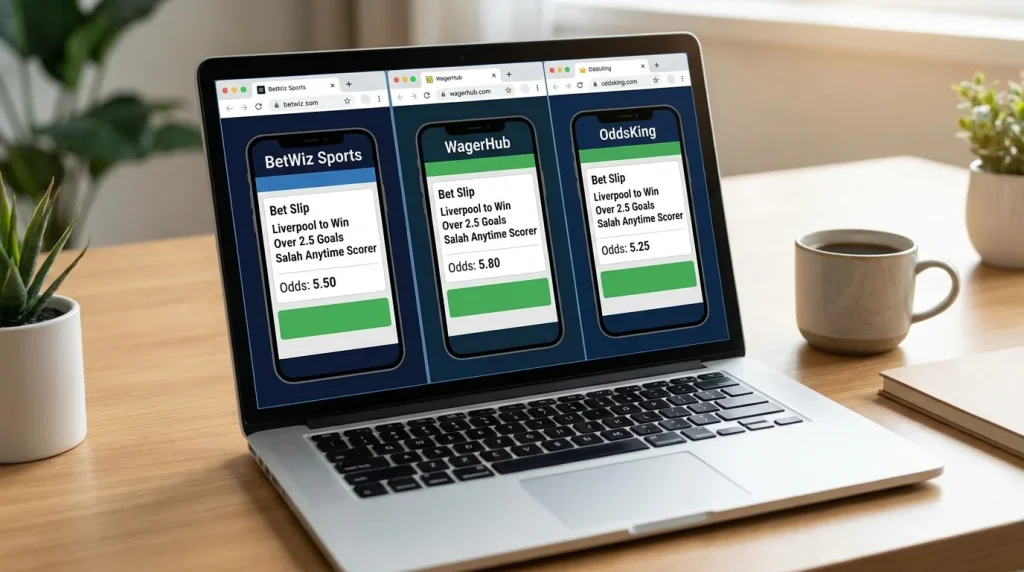
Sports betting accounts for 57.1% of UK online gambling revenue, and bet builders are becoming a significant share of that. The pricing variance exists because each platform uses a different proprietary algorithm to model intra-match correlation. Some algorithms are more sophisticated than others; some apply higher margins; some handle certain leg types better. The simplest edge in bet builder betting is platform comparison — building your combination on one site, then checking the price across two or three others before placing. This takes under a minute and can add 10-20% to your odds on the same bet.
Beyond platform comparison, the structural edge in bet builder pricing is the margin layering. Each leg carries its own margin, and the combined bet builder price includes an additional “complexity margin” — a fee for the computational work of modelling the correlations. This complexity margin varies by the number of legs and the types involved. Two-leg bet builders carry minimal complexity margin (sometimes none — the bookmaker uses them as a loss leader to draw you towards higher-leg builds). Three and four-leg builders carry moderate complexity margins. Five-leg and above carry substantial margins that often eliminate any value, no matter how good your analysis is.
My sweet spot is three to four legs. The correlation modelling is sophisticated enough to produce reasonable prices, the complexity margin is manageable, and the number of legs is small enough that I can genuinely assess the probability of all legs landing simultaneously. Beyond four legs, the combinatorial uncertainty overwhelms my ability to estimate accurately, and I am effectively guessing — which is what the bookmaker wants.
Building a Bet Builder — Step-by-Step Example
Let me walk through an actual bet builder construction to show how the process works in practice. This is based on a real fixture from last season — I have removed the team names to focus on the method rather than the specific result.
The fixture: a home side ranked seventh, averaging 1.9 xG per home match, facing an away side ranked 14th, conceding 1.6 xGA per away match. The home side plays a high-pressing 4-3-3 with wide forwards who cut inside and shoot frequently. The away side plays a mid-block 4-4-2 that concedes chances primarily through wide areas but has a centre-forward averaging 3.1 shots per match.
Step one: identify the match scenario. High-pressing home side against a mid-block away team with a dangerous striker. The likely match state is home dominance with the away side threatening on the counter. This scenario produces goals, shots, and corners from the home side, with the away striker getting isolated chances.

Step two: select legs that align with the scenario. I choose: Home Win (implied probability from my model: 58%), Over 2.5 Goals (my estimate: 62%), Home Team Over 5.5 Corners (my estimate: 65%), and Away Centre-Forward 1+ Shots on Target (my estimate: 72%). All four legs are positively correlated with the same match scenario — home dominance with the away side countering — and no two legs contradict each other.
Step three: estimate the combined probability. Because the legs are positively correlated, I cannot simply multiply the individual probabilities. Instead, I estimate a conditional chain: if the home side wins (58%), the probability of over 2.5 goals given a home win is higher than the unconditional 62% — I estimate 75%. The probability of 6+ home corners given a home win with over 2.5 goals is similarly elevated — I estimate 78%. And the away striker getting a shot on target given an open, high-scoring match is 80%. The conditional chain gives me: 0.58 x 0.75 x 0.78 x 0.80 = 27.1%.
Step four: compare with the offered price. The bet builder platform offers 4.50, which implies 22.2% probability. My estimate is 27.1%. That is a 4.9 percentage-point edge — substantial and well above my 3% minimum threshold. I place the bet.
Over 70% of UK sports bets are placed in-play, but I build bet builders pre-match because the pricing is set before kick-off and cannot be adjusted once placed. The in-play equivalent would be a cash-out decision, which is a separate calculation entirely. For the pre-match build, the discipline is in the process: scenario first, legs second, probability third, price comparison fourth. Skip any step and you are gambling, not betting.
Bet Builder Features by Bookmaker
Not all bet builder platforms are equal, and the differences matter more than most punters realise. I have used bet builders across seven UK-licensed platforms over the last three years and tracked the pricing, leg availability, and user experience systematically.
The key differentiator is leg variety. Some platforms offer result, goals, and basic player props (scorer, cards). Others add corners, shots on target, passes, tackles, and even goalkeeper saves. The platforms with the widest leg menu give you more flexibility to construct non-standard combinations — the exotic builds where pricing edges are largest. Nearly one in ten UK adults bets on sport at least once a month, and among those punters, 87% of men placed a bet in 2025. That enormous user base means bookmakers compete aggressively on bet builder features, and the product is improving rapidly.
Pricing generosity varies by platform and, frustratingly, by fixture. I have found that some platforms consistently offer longer bet builder prices on lower-profile fixtures (Championship, League One) while others are more competitive on Premier League matches. This is likely driven by their liquidity models — platforms with more recreational traffic on big matches can afford tighter prices there because the volume compensates, while they widen margins on smaller fixtures where they carry more risk.
Cash-out availability is another significant variable. Some platforms offer full cash-out on bet builders; others offer partial cash-out; a few offer none. If your strategy involves monitoring the match live and cashing out when enough legs have landed to lock in a profit, you need a platform that supports this. I prefer platforms with partial cash-out because it lets me take some profit while leaving a portion running — a hybrid approach that manages risk without forfeiting the full upside.
My practical advice: maintain active accounts with at least three platforms that offer bet builder products. Build your combination mentally, then check the price on all three before placing. The price difference between platforms on the same four-leg bet builder regularly exceeds 15%, which is the easiest value you will ever find in football betting. Loyalty to a single platform in the bet builder market costs you money every single week.

Frequently Asked Questions
Which bookmaker has the best bet builder product in the UK?
No single platform leads across all categories. The best approach is to maintain accounts with three or more operators and compare prices for each specific combination. Leg variety, pricing generosity, and cash-out options vary between platforms and even between fixtures on the same platform. I check at least three prices before placing any bet builder.
Can you cash out a bet builder before the match ends?
Most UK platforms now offer full or partial cash-out on bet builders, though availability can depend on the specific legs included and how the match is unfolding. Player-prop legs sometimes restrict cash-out options because the bookmaker cannot accurately reprice them live. Always check the cash-out terms on your chosen platform before placing the bet if live management is part of your strategy.
How do correlated legs inside a bet builder affect the combined price?
Positively correlated legs — where one outcome makes another more likely — should produce a lower combined price than multiplying the individual odds. The bet builder algorithm adjusts for this, but the adjustment is imperfect, especially for less common leg combinations. Negatively correlated legs create contradictory scenarios and typically produce poor-value combined prices. I avoid any combination where the legs work against each other.
Are bet builders better value than separate single bets?
Not inherently. A bet builder carries a complexity margin that individual singles do not. However, the correlation adjustment in a bet builder can produce better prices than a naive accumulator of the same legs priced independently. The value depends entirely on whether your estimated combined probability exceeds the bet builder"s implied probability after margins. Three to four legs is the sweet spot where the complexity margin is manageable and genuine value can exist.
Articles
Prepared by the Football Bet Today editorial staff.
