
Football Accumulator Tips — How to Build Data-Backed Accas
 Available in US
Why Most Accumulators Lose — and How Yours Won’t
I placed my first football accumulator in 2014. Five legs, all “certainties” from the Saturday 3pm kick-offs. Four landed. The fifth — a League Two home banker — lost to a 93rd-minute equaliser. That single leg cost me a four-figure return, and it taught me something every serious punter eventually learns: accumulators are not designed for you to win. They are designed for bookmakers to collect.

That sounds bleak, but it is also the starting point of everything useful I have to say about accas. Sports betting accounts for 57.1% of all UK online gambling revenue, and a huge chunk of that flows through accumulators because they combine low stakes with enormous potential payouts — the perfect dopamine trap. Bookmakers love them precisely because the implied margin compounds with every leg you add. A 5% edge per leg becomes a 23% edge across a five-fold. The house does not need luck; it needs you to keep adding legs.
So why am I writing a guide on how to build them? Because accumulators are not inherently irrational. The problem is not the format — it is how most punters use it. Over a decade of tracking my own acca results, I have found that a disciplined, data-first approach turns the accumulator from a lottery ticket into a structured bet with identifiable edges. The key is treating each leg as an independent analytical exercise and understanding where the real traps hide — correlation, staking errors and the seductive illusion of “near-misses” that keep you chasing.
This guide breaks down the entire process: how to identify correlated legs that silently destroy your expected value, how to filter selections through five data checkpoints, and how to stake accumulators without letting a bad weekend wipe out a month of discipline. If you are here for a list of today’s “banker picks” with no reasoning behind them, you are in the wrong place. If you want to understand why your accas keep losing and what to change, read on.
Leg Correlation — the Mistake That Kills Accas
A few years back I built what I thought was a rock-solid Saturday acca: Manchester City to win, Over 2.5 goals in the same match, and Both Teams to Score. Three separate “legs,” three separate prices. Except they were not separate at all. If City win, they almost certainly score, which means BTTS is already halfway home. If the match produces three or more goals, the chances of both sides scoring jump dramatically. I had effectively placed the same bet three times and paid a combined price as though each outcome were independent. The bookmaker priced each leg individually, but the real-world probabilities were tangled together — and the overlap was entirely in the bookmaker’s favour.
This is correlation, and it is the single biggest structural mistake in accumulator building. When two or more legs in your acca depend on the same underlying event or condition, the true combined probability is higher than the product of individual probabilities suggests. You are paying for independence that does not exist.
Positive correlation works like this: Leg A happening makes Leg B more likely. City win + Over 2.5 in the same match is a textbook case. If City are winning, they have scored at least once, and unless the match is a grinding 1-0, there are goals flying in — exactly the scenario that produces overs. The bookmaker prices these legs as if they are unrelated, but in practice they cluster together. You get worse combined odds than the true probability warrants.
Negative correlation is rarer in accas but equally important to understand. Backing two teams in the same match — say, Draw No Bet on both sides — creates a situation where both legs literally cannot win simultaneously. Most punters would never do this consciously, but subtler versions creep in. Backing Team A to win and Under 1.5 goals in a different match where Team A’s striker is also in your anytime goalscorer bet creates a web of contradictory assumptions.
The practical fix is straightforward but requires discipline. First, never combine two legs from the same match unless you have explicitly modelled the conditional probability. A bet builder is the right vehicle for same-match combinations because at least the bookmaker’s algorithm accounts for some correlation in the pricing. Second, for cross-match accas, ask a simple question about every pair of legs: “If Leg A wins, does that change the likelihood of Leg B winning?” If the answer is yes — even slightly — either drop one leg or accept that you are overpaying.
I run a quick mental check on every acca I build now. I list the legs in a column and draw arrows between any two that share a causal link: same league, same weather conditions, same kick-off time creating “results-awareness” effects. If more than one arrow exists, I rework the selection. It takes two minutes and has saved me from dozens of bad bets over the years. Correlation is invisible in the bet slip, but it is the reason the bookmaker offers you that tempting combined price in the first place.

Picking Legs — A Five-Filter Data Process
Every Saturday morning I watch the same thing happen in betting forums: someone posts a 10-fold acca built entirely on gut feeling and team loyalty, then asks the community whether it “looks good.” It never looks good, because there is no process behind it. Picking acca legs without a repeatable filter is like grocery shopping without a list — you end up with a trolley full of things you do not need and nothing that actually makes a meal.
I use five filters, applied in sequence. A selection has to pass all five before it earns a spot in my accumulator. Here is the process.
Filter 1: Form over reputation. I ignore the table and look at last-six-match form — specifically results, xG created and xG conceded. A mid-table side on a run of four wins with an xG surplus of +1.2 per match is a far better acca leg than a top-six club sleepwalking through a fixture on -0.3 xG differential. Football generates roughly 5.8% of the UK population placing bets on it every week, which means the most popular matches carry the sharpest prices. Form gives you a lens to see past the public perception that keeps those prices tight.
Filter 2: Home-away context. Not all home advantages are equal. Some sides are fortresses at home but toothless away; others are the reverse. I split form into home-only and away-only records and look at the delta. A team winning 80% at home but just 20% away is a strong home leg but a terrible away one, even if their overall form reads well. The monthly volume of online bets placed in the UK — roughly 290 million — means bookmakers adjust for this too, but their models lag behind abrupt form shifts by a few weeks, and that lag is exploitable.
Filter 3: Head-to-head relevance. I check the last five meetings between the two sides, but only if the sample is recent and relevant. A head-to-head record from 2018 when both squads have since been overhauled tells you nothing. What I look for are repeated patterns — the same team conceding first, the same fixture consistently producing over 2.5 goals, or a ground where the away side historically performs above expectation. If no clear pattern exists, this filter is neutral, and I move on.
Filter 4: Line-up and injury check. This is the filter most punters skip because it requires waiting until team news drops, usually an hour before kick-off. I have lost count of the accas I have seen torpedoed because a key striker was rested for a midweek European tie and the punter did not check. I treat confirmed line-ups as non-negotiable. If a key absence changes the dynamic — a first-choice goalkeeper out, a main creative midfielder injured — the leg gets dropped, no matter how good the data looked before.
Filter 5: Price check. Even if a selection passes the first four filters, I need the odds to reflect genuine value. I compare the implied probability from the offered price against my own estimated probability from the data. If the bookmaker’s price implies a 70% chance and my model says 75%, that is a marginal edge — enough for a single, but thin for an acca leg where any slippage compounds. I want at least a 5% gap between my estimate and the implied probability before a leg earns its place. This value-first approach is what separates a structured acca from a wish list.
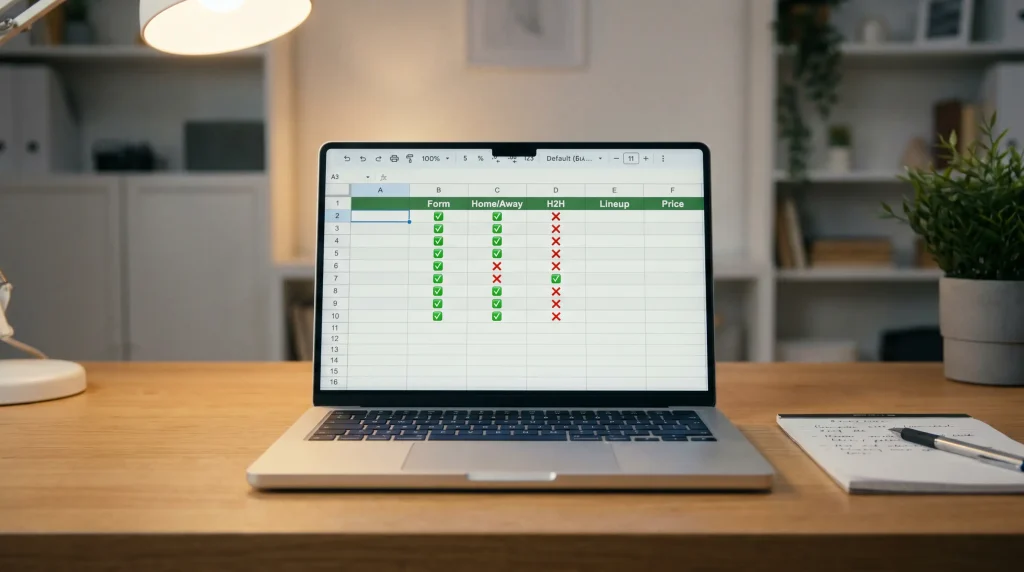
Running five filters sounds time-consuming, but in practice it takes about 20 minutes per fixture once you know where to find the data. I keep a simple spreadsheet with columns for each filter and a pass/fail marker. On a typical Saturday with 15 fixtures, I might find six or seven selections that pass all five — and I build my acca from that shortlist, not from the full card.
Staking Accumulators Without Blowing the Bank
The most profitable acca I ever placed returned 14/1 from a four-fold on a midweek EFL card. My stake was two pounds. The reason it was two pounds — not twenty, not fifty — is the same reason I still have a betting bankroll at all: I treat accumulator stakes as entertainment money, never as investment capital.
Here is the maths that most punters refuse to confront. A well-constructed four-fold with an average leg probability of 65% has a combined win probability of roughly 18%. That means it loses more than four times out of five. A five-fold drops to about 12%. A seven-fold sits under 5%. You can be right on every individual assessment and still lose the acca because the combinatorial maths works against you. Staking as though you expect to win is a fast route to a blown bankroll.
My rule is simple: never stake more than 1% of my bankroll on any single accumulator. If my bankroll is 500 pounds, an acca gets a fiver — maximum. This feels underwhelming when you see a potential 20/1 return, but it achieves something critical: it lets you survive the losing runs. And losing runs in acca betting are long. I have gone 15 consecutive accas without a winner, which at 1% stakes costs 15% of the bankroll. Painful, but recoverable. At 5% stakes, the same run would cost 75%. At 10%, you are finished.

A second principle I follow is separating acca stakes from single-bet stakes entirely. I allocate 10-15% of my total bankroll as an “acca budget” for the month. Once that budget is gone, I stop placing accas until the next month, regardless of how many “certainties” the weekend card throws up. This ring-fencing prevents the common pattern of chasing losses with ever-larger accas, which is the fastest way to destroy a bankroll I know of.
One more thing on staking: resist the urge to increase your stake because you “feel confident” about a particular acca. Confidence is not a data point. If your filter process is sound, every acca you place should already represent your best available selections. Varying your stake based on emotional confidence introduces exactly the kind of noise that disciplined betting is designed to eliminate.
Acca Insurance and Boosts — What’s Actually Worth Taking
Last autumn a major bookmaker offered me “acca insurance” on a five-fold — if one leg let me down, I would get my stake back as a free bet. Sounds generous, right? I took five minutes to calculate the actual value of that offer, and the answer was less impressive than the marketing suggested.
Acca insurance typically refunds your stake as a free bet (not cash) if exactly one leg loses. The catch is in that word “exactly.” If two legs lose, you get nothing. And a free bet is worth roughly 70-80% of its face value because you do not get the stake back when you use it. So the real value of acca insurance on a five-pound five-fold is not five pounds — it is closer to three pounds fifty, and only in the specific scenario where exactly one leg fails. The probability of that scenario depends on your leg probabilities, but for a typical five-fold it sits around 30-35%. Multiply the conditional value by the probability and you get an expected benefit of roughly one pound to one pound twenty. Not nothing, but not the game-changer the advertising implies.

Acca boosts are a different proposition. A bookmaker adds 10%, 20% or sometimes more to your accumulator winnings. The maths here is more straightforward: a 10% boost on a 10/1 acca turns it into 11/1. That is genuine added value — but only if the underlying acca is already a sound bet. A 10% boost on a bad acca is still a bad acca. Over 70% of UK online sports bets are now placed in-play, which means bookmakers have enormous data on how punters behave. Acca boosts are calibrated to encourage higher-leg-count accumulators where the bookmaker’s compounded margin already dwarfs the boost. A 20% boost on an eight-fold where the bookmaker holds a 35% cumulative edge is a net negative for the punter every time.
My approach: I use acca insurance opportunistically when I am already placing a four or five-fold that passes my filters. I never add extra legs to qualify for insurance, and I never build an acca specifically because a boost is available. The promotion should fit the bet, not the other way around. If the only reason you are placing an acca is the offer, you are the product, not the customer.
Weekend Acca Workflow — Saturday to Sunday
Saturday mornings have a rhythm to them now. Coffee, laptop, and the same spreadsheet I have used for the last three seasons. By 11am I have reviewed every 3pm kick-off in England and Scotland, filtered each through the five-step process, and narrowed the card down to a handful of viable legs. By 1pm, when team news starts dropping, I am either building the acca or deciding there is nothing worth backing — which happens more often than you might think.

The weekend workflow matters because Saturday’s schedule is unique in English football. You get eight to ten simultaneous 3pm kick-offs across the Premier League, Championship, League One and League Two — the densest fixture window of the week. That density creates opportunity, but also danger. Nearly one in ten UK adults places a sports bet at least once a month, and Saturday is when the bulk of that activity concentrates. The sheer volume of casual money flowing into the market on Saturdays can actually move prices, particularly in lower-league matches where liquidity is thinner.
My Saturday process looks like this. First, I pull up the fixture list and immediately eliminate any match where I have no data edge — derbies with unpredictable dynamics, matches between two sides in identical form, or fixtures involving teams I have not tracked closely enough this season. Eliminating matches is more important than selecting them. A tight acca built from three strong legs beats a six-fold padded with guesswork every single time.
Second, I check for correlated fixtures. Simultaneous 3pm kick-offs rarely create direct correlation issues — unlike a Monday night standalone where narrative effects can spill over — but weather is a real factor. If heavy rain is forecast across the north of England, multiple matches in that region might trend towards unders, and backing overs in three separate rain-soaked fixtures is effectively making the same environmental bet three times.
Sunday is a different animal. The slate is smaller — often just one or two Premier League matches plus a handful of lower-league fixtures. Smaller slates mean less selection pressure: I might find one strong leg on a Sunday and add it to a Monday-Tuesday midweek card rather than forcing a standalone Sunday acca. The temptation to “have something on” for the Sunday match is one of the most expensive habits in recreational betting. If the data says no, the answer is no, regardless of how bored you are at 4pm.
One final workflow note: I always wait for confirmed line-ups before placing. This means my accas go on between 2pm and 2:45pm on Saturdays, not the night before. I know that waiting feels like missing out, especially when early prices are sometimes better. But the value of confirmed information — knowing the actual eleven players on the pitch — outweighs any marginal early-price advantage. I have never regretted waiting for team news. I have regretted ignoring it dozens of times.
Doubles and Trebles vs Full Accas — The Numbers
Here is a question I get asked constantly: “Should I just do doubles and trebles instead of full accas?” The answer, like most things in betting, lives in the numbers — and the numbers strongly favour smaller multiples.
Take four selections, each priced at 2.00 (evens). A four-fold returns 16.00 for a one-pound stake. Now split those same four selections into six doubles. Each double returns 4.00, so six doubles cost six pounds and if all four selections win, all six doubles land — returning 24.00 for a six-pound outlay, a net profit of 18.00 versus 15.00 from the four-fold. But here is where it gets interesting: if three out of four win, the four-fold returns nothing — total loss. The six doubles return three winning bets at 4.00 each — 12.00, against the six-pound stake. You are still in profit despite one selection losing.
This resilience is the core advantage of smaller multiples. A full acca is binary — everything wins or everything loses. Doubles and trebles create a gradient of outcomes where partial success still generates returns. Over hundreds of bets, this gradient smooths out the variance enormously. My own tracking data shows that switching from five-folds to a combination of doubles and trebles — covering the same selections — reduced my monthly variance by roughly 40% while maintaining a comparable return on investment.
The trade-off is obvious: smaller multiples require a larger total stake to cover the same selections. Six doubles cost six times a single four-fold. If your bankroll is small, this is a genuine constraint. My approach is to use doubles and trebles as the backbone of my weekend betting — covering three to four strong selections in all possible two-way and three-way combinations — and reserve the full acca for occasions when I have an unusually high-conviction set of legs and the combined odds justify the risk.
There is also a psychological benefit to smaller multiples that is easy to underestimate. When you place a six-fold and one leg loses in the first five minutes, the entire bet is dead and the rest of the afternoon feels pointless. When you place doubles and trebles covering the same selections, one early loss reduces your exposure but does not eliminate it. You stay engaged, you make better in-play decisions, and you are less likely to chase with an impulsive replacement acca. Betting is a long game, and anything that keeps you making rational decisions across a full weekend card is worth the extra stake outlay.
Frequently Asked Questions
How many legs should a football accumulator have?
Three to five legs is the sweet spot for most punters. Fewer than three and the combined odds rarely justify an acca over singles. More than five and the compounded bookmaker margin erodes your expected value to the point where even well-researched selections become a losing proposition long-term. I rarely go above four legs, and I never go above six.
Does correlation between acca legs matter for expected value?
It matters enormously. Correlated legs — such as combining a match result with over 2.5 goals from the same fixture — mean the true combined probability is higher than the bookmaker"s separate prices imply. You end up overpaying for the acca relative to the real chance of all legs landing. Keeping legs independent across different matches is one of the simplest ways to improve long-term acca results.
Is it better to split an accumulator into smaller multiples?
In most cases, yes. Covering the same selections as doubles and trebles rather than a single large acca reduces variance and allows partial success to generate returns. The total stake is higher, but the probability of a positive return on any given weekend increases significantly. Full accas make sense occasionally for high-conviction selections, but smaller multiples should be the default.
How do acca boosts change the real odds?
An acca boost adds a percentage to your potential winnings — typically 10% to 50% depending on the number of legs. The actual value depends on the bookmaker"s built-in margin. A 20% boost on a six-fold where the cumulative margin is already 30%+ still leaves you with negative expected value. Boosts are worth taking when the underlying acca already passes your selection filters, but they should never be the reason you place the bet.
Articles
Prepared by the Football Bet Today editorial staff.
